
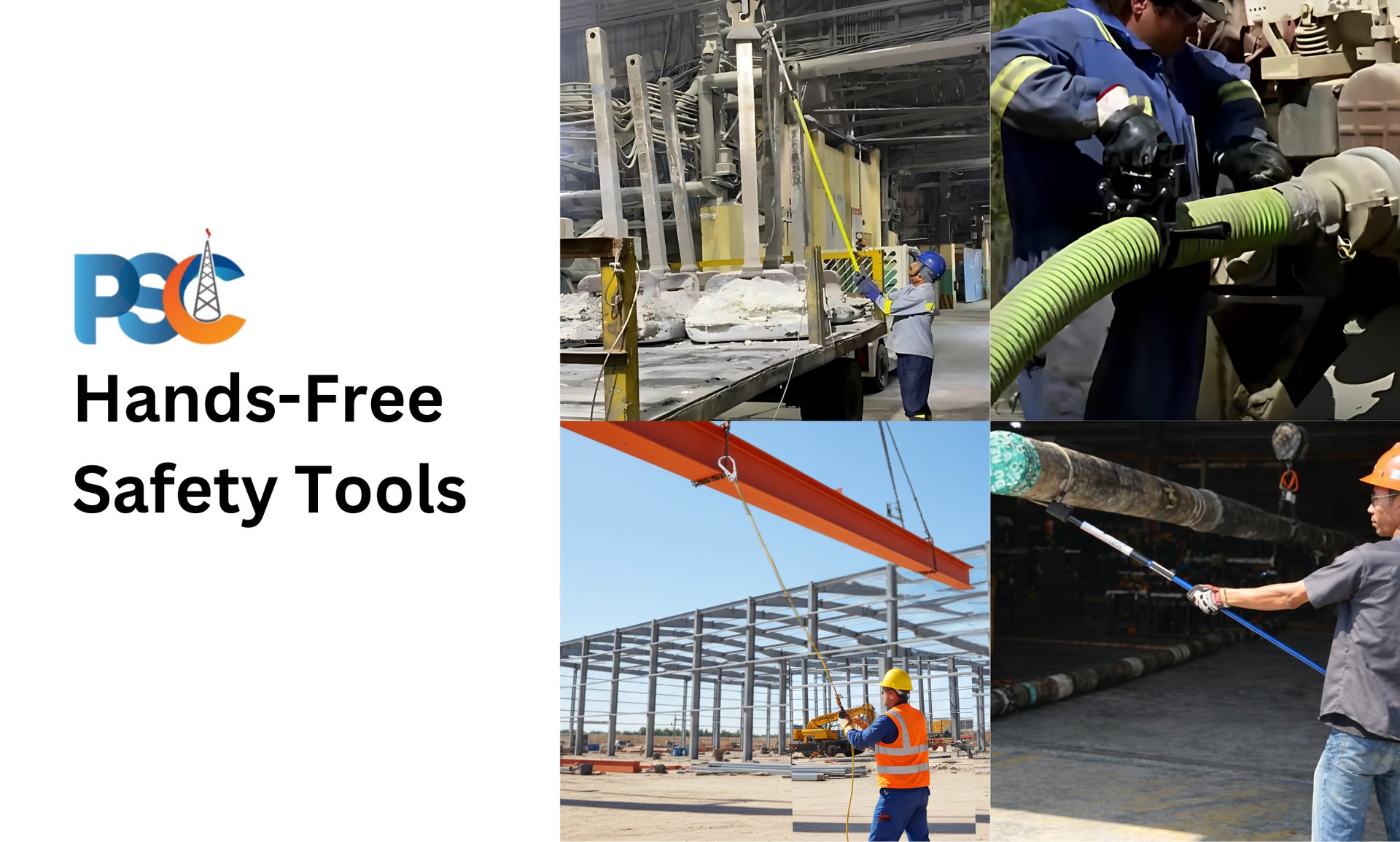
PSC Hands-Free Safety Tools
Why PSC Hands-Free Safety Tools?
Hand injuries are among the most frequent and costly incidents in heavy industries. Whether during lifting operations, pipe handling, equipment alignment, or striking tasks, hands are often the first body part exposed to pinch points, crush zones, caught-between hazards, and impact areas. In high-risk environments where loads are heavy and energy transfer is unpredictable, relying on human reflexes alone is not enough to prevent injury.
Hands-Free Safety is essential because it replaces instinctive manual contact with engineered control. Instead of placing hands near suspended
loads, rotating equipment, or striking zones, workers use structured methods that create safe distance and controlled force application. By physically separating personnel from hazardous energy, PSC Hands-Free Safety Tools significantly reduces the likelihood of finger amputations, crush injuries, fractures, and long-term musculoskeletal disorders.
More importantly, Hands-Free Safety transforms the way work is performed. It shifts safety from being behavior-dependent to being engineering-driven. This approach improves load stability, enhances positioning accuracy, reduces fatigue, and strengthens overall operational discipline.
PSC Hands-Free Safety Tools in Heavy Industries
A Modern Engineering Approach to Eliminating Hand Injuries
In heavy industries such as oil & gas, construction, mining, shipyards, fabrication, logistics, and power generation, hand and finger injuries remain among the most common and severe workplace incidents. These injuries frequently result from pinch points, crush hazards, caught-between situations, and impact exposures during lifting, rigging, positioning, and mechanical tasks.
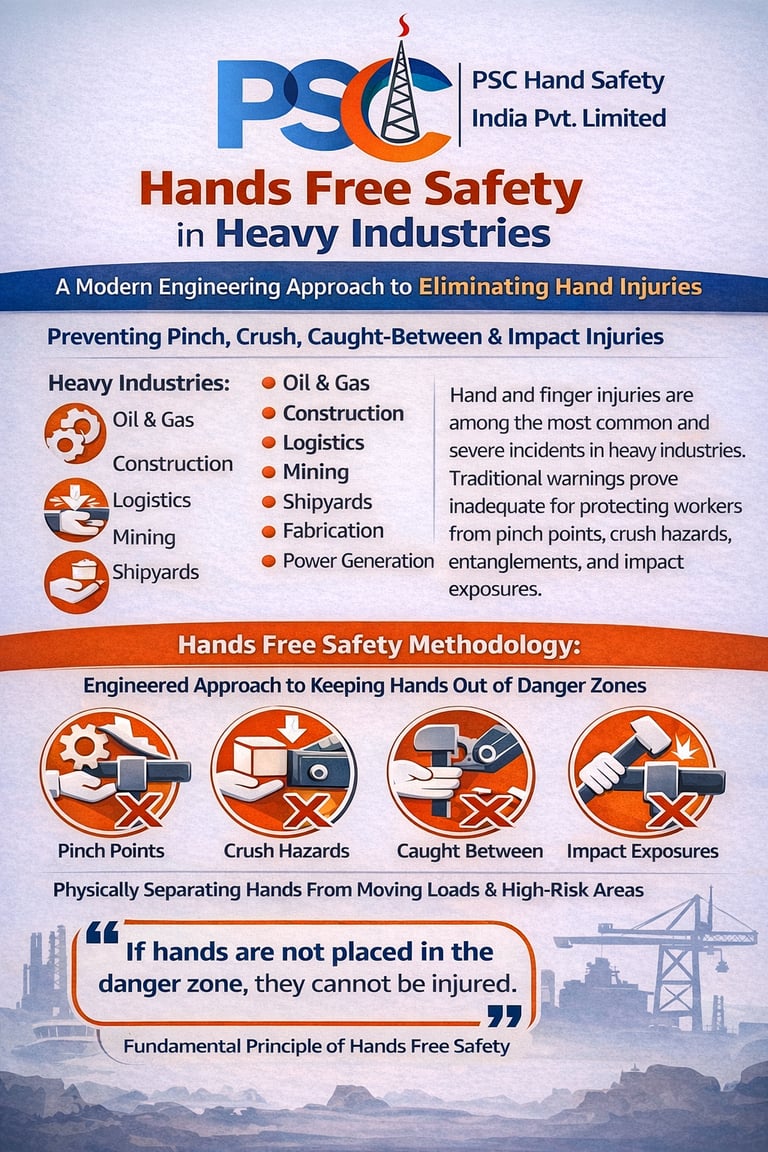
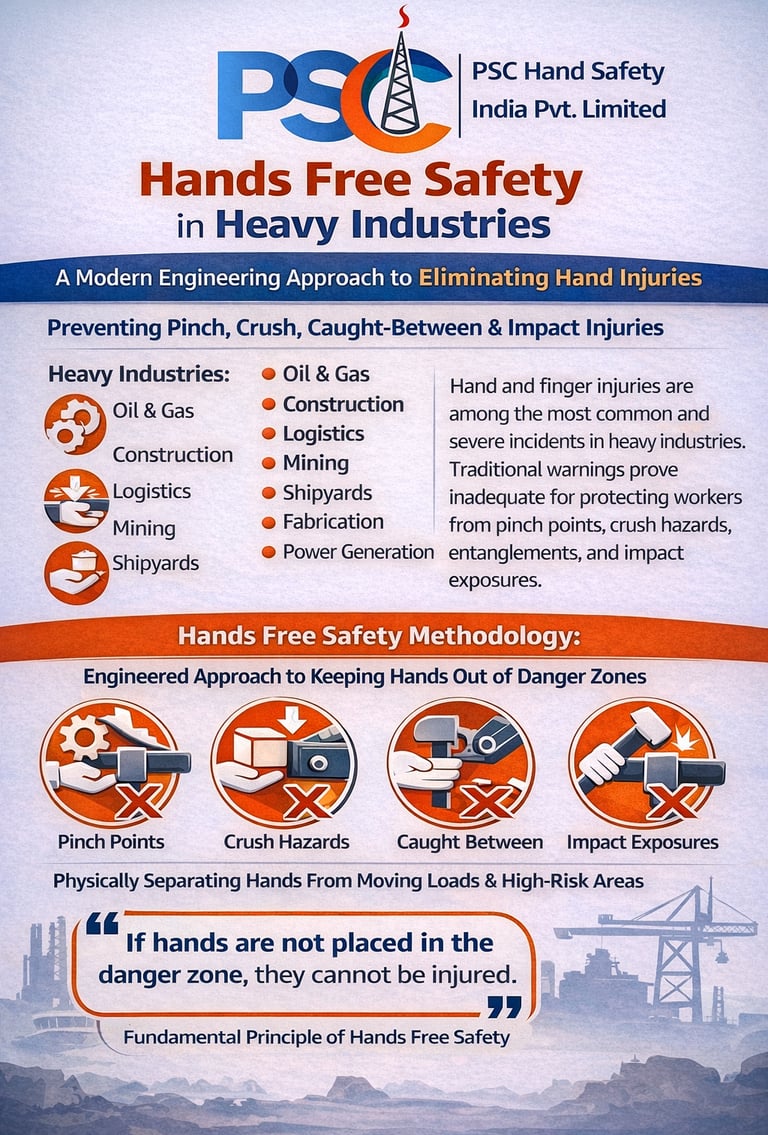
Hands free safety is a structured, engineering-based safety methodology designed to eliminate these injuries by physically separating workers’ hands from hazardous zones. Instead of relying solely on warnings or behavioral reminders, hands free safety introduces controlled, tool-assisted work methods that prevent direct contact with moving loads and high-risk areas.
At its core, hands free safety is built on one fundamental principle:
If hands are not placed in the danger zone, they cannot be injured.
Why Hand Injuries Continue to Happen — And Why Hands Free Safety Is Necessary
Understanding the Real Risk Environment
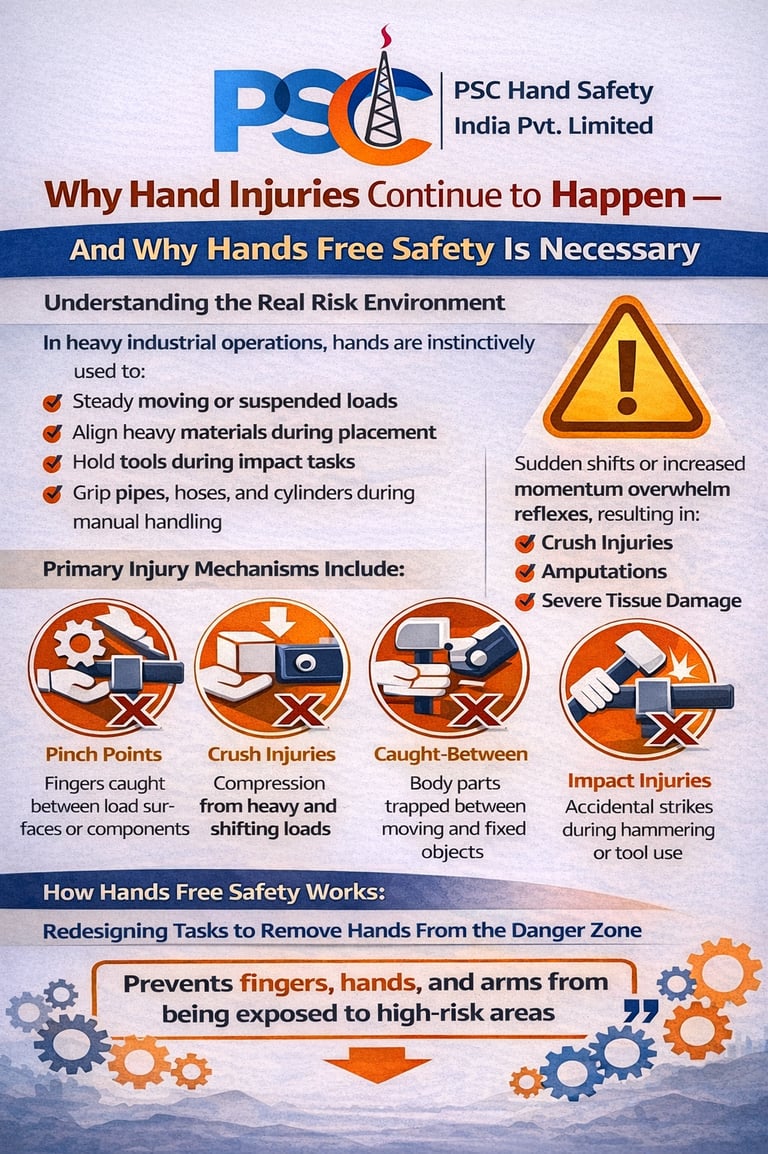
In heavy industrial operations, hands are instinctively used to:
• Steady moving or suspended loads
• Align heavy materials during placement
• Hold tools during impact tasks
• Grip pipes, hoses, and cylinders during manual handling
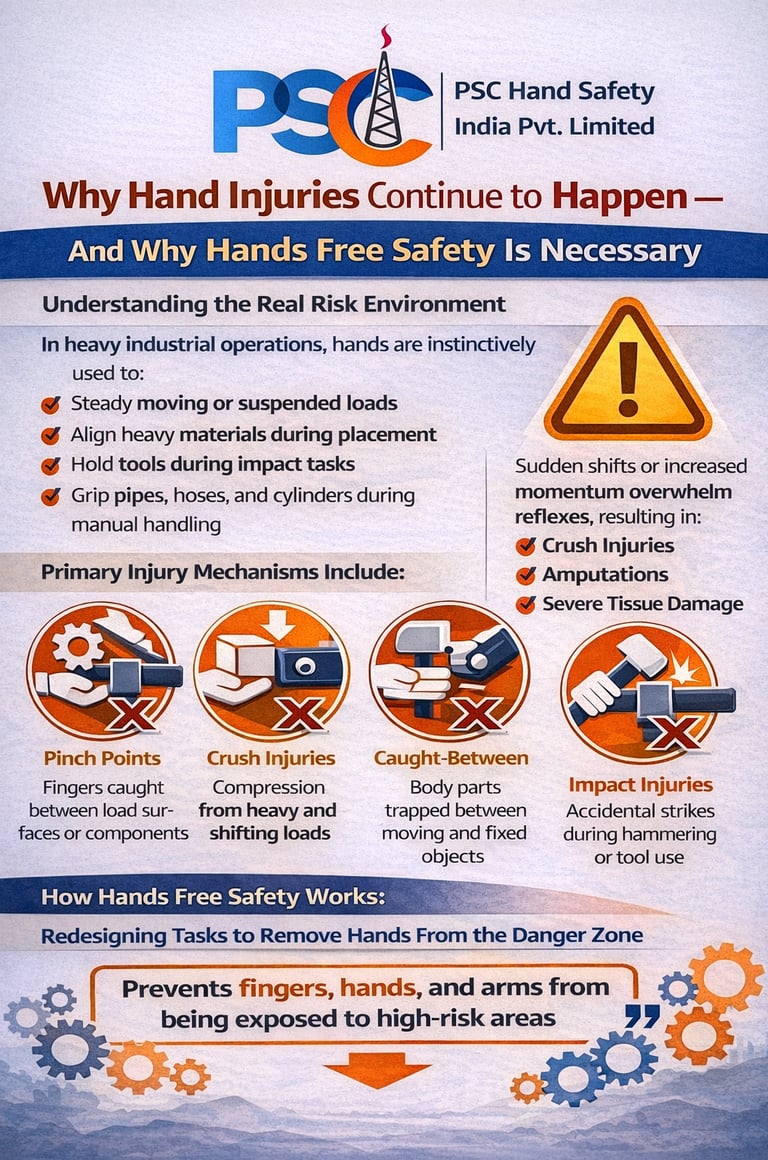
When loads shift unexpectedly or momentum increases, the force generated far exceeds human reaction capability. A worker attempting to “catch” or stop a moving object often results in crush injuries, fractures, amputations, or severe soft tissue damage.
The primary injury mechanisms include:
• Pinch Points: Fingers trapped between load surfaces or structural components
• Crush Injuries: Compression from heavy shifting loads
• Caught-Between Incidents: Body parts trapped between moving and fixed objects
• Impact Injuries: Accidental strikes during hammering or tool use
Hands free safety addresses these hazards by changing the method of work — not just warning about the risks. By redesigning tasks using hands free safety principles, exposure to hazardous energy is significantly reduced.
The Engineering Foundation of Hands Free Safety
Replacing Instinct with Controlled Systems
Hands free safety operates through three key engineering controls:
1. Distance and Standoff Control – Creating Safe Separation
Hands free safety increases the physical distance between workers and suspended or moving loads, significantly reducing exposure to injury. Long-reach guidance systems and control lines allow operators to maneuver loads from outside fall and pinch zones.
2. Controlled Force Application – Replacing Hands with Mechanical Advantage
Instead of applying force directly with hands, hands free safety uses engineered extensions that allow safe pushing, pulling, and guiding without direct contact.
3. Predictable Load Behavior – Managing Energy Before It Causes Harm
Hands free safety stabilization systems and control methods reduce unpredictable swing, rotation, and sudden load shifts, which are primary causes of caught-between injuries.
Where Lifting Operations Become Dangerous
How PSC Hands-Free Safety Tools Eliminates Pinch and Crush Exposure
During suspended load handling, the highest risk occurs during:
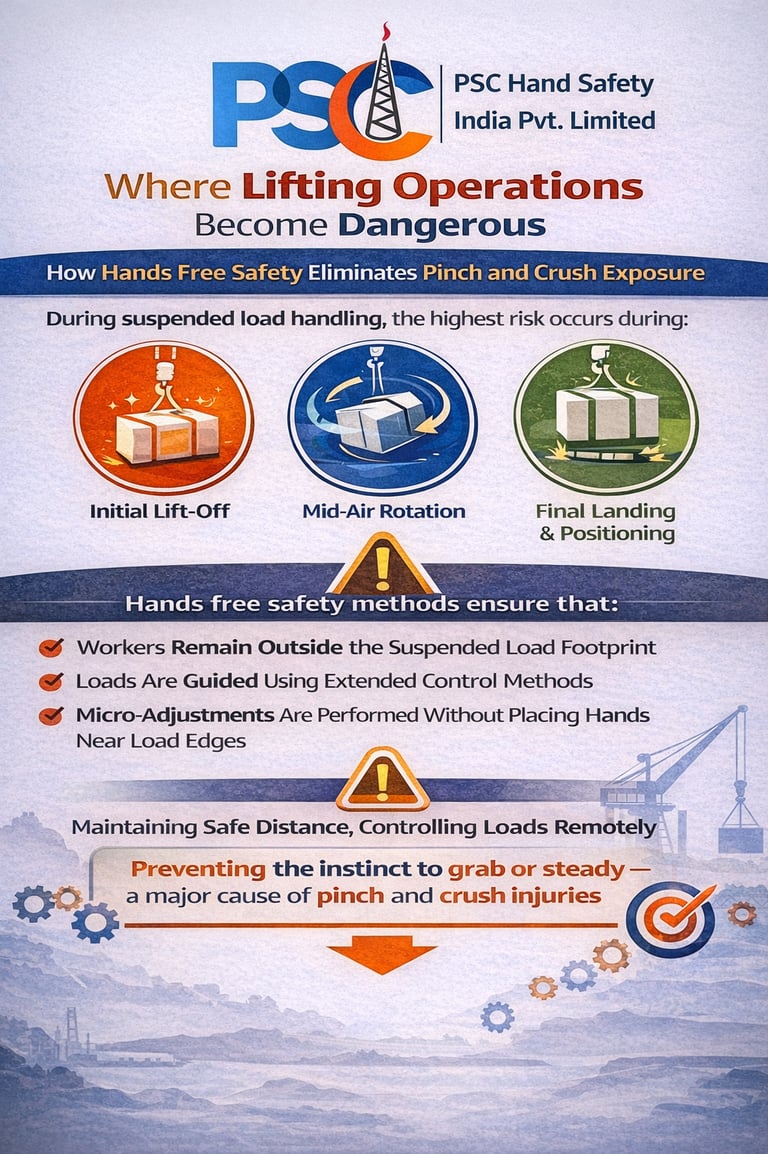
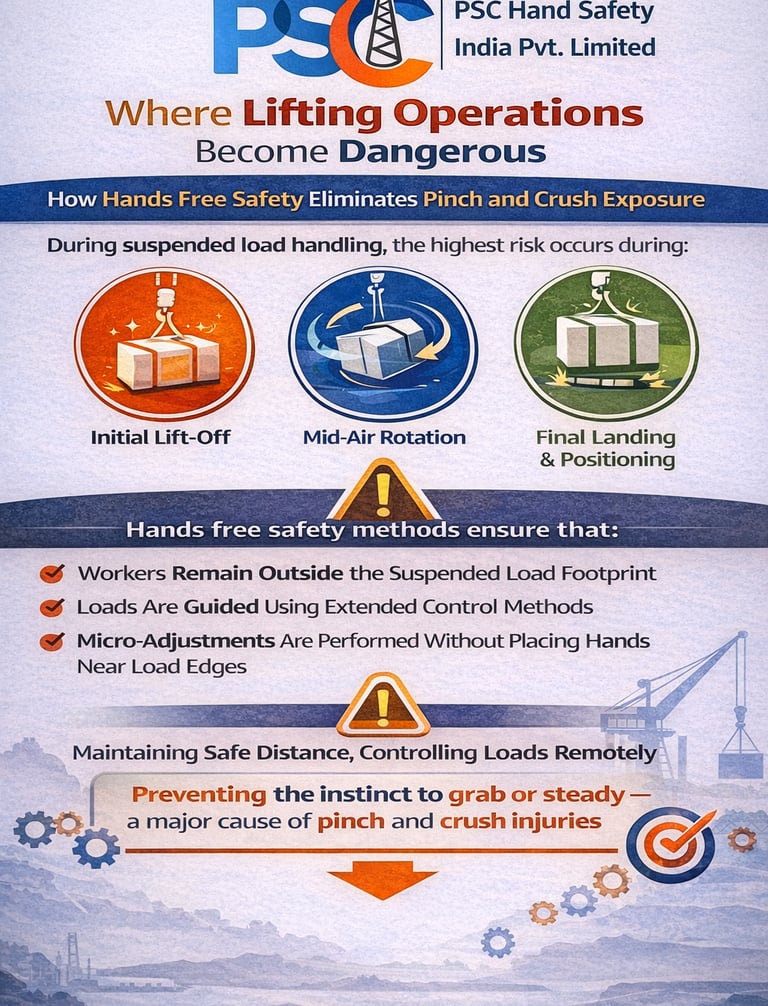
• Initial lift-off
• Mid-air rotation
• Final landing and positioning
Hands free safety methods ensure that:
• Workers remain outside the suspended load footprint
• Loads are guided using extended control methods
• Micro-adjustments are performed without placing hands near load edges
By maintaining safe distance and applying controlled guidance, hands free safety eliminates the instinct to manually grab or steady loads — the root cause of many injuries.
Controlling Swing with PSC Hands-Free Safety Tools
Managing Suspended Loads Using Physics, Not Force
Suspended loads behave like pendulums. Sudden crane acceleration, wind forces, or uneven rigging can create oscillation. Hands free safety controls this by:
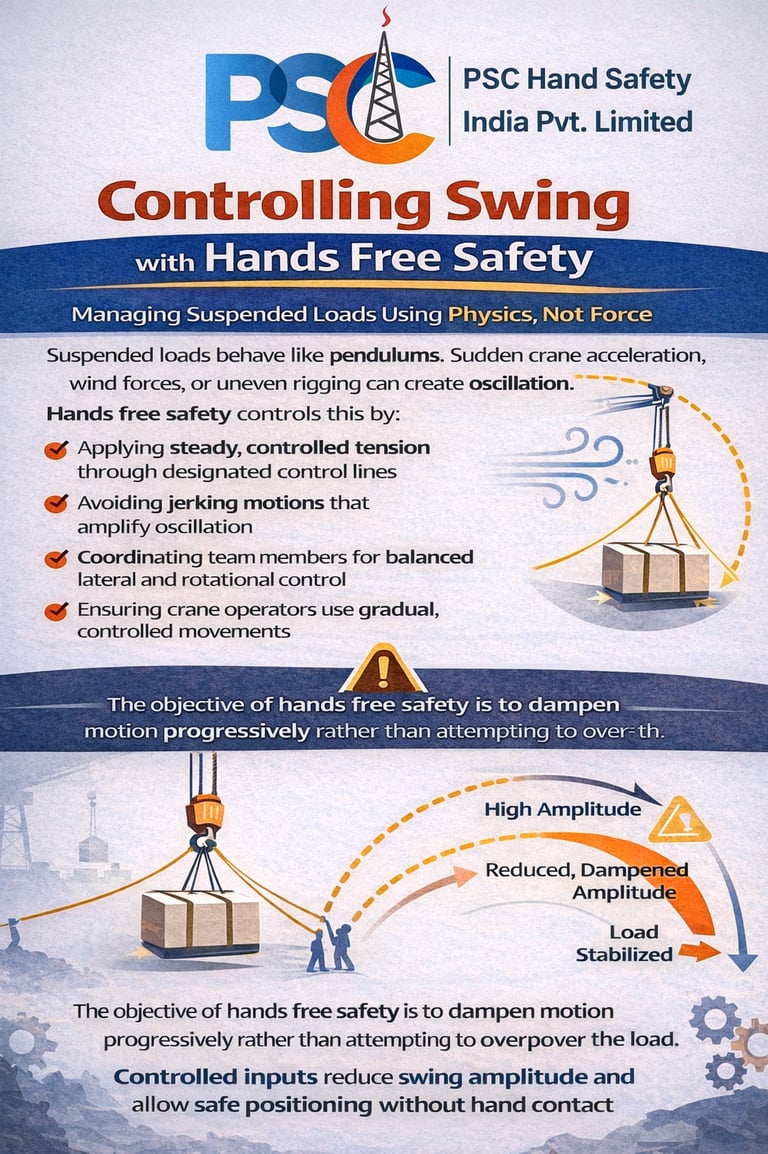
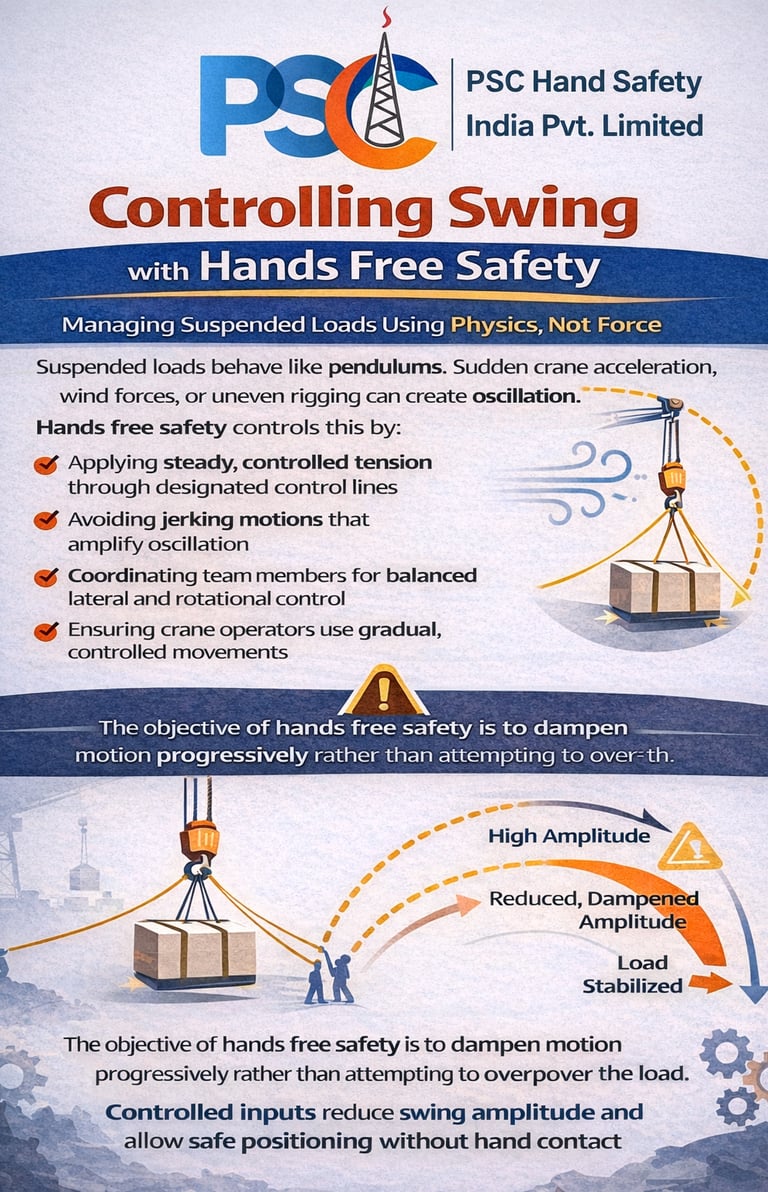
• Applying steady, controlled tension through designated control lines
• Avoiding jerking motions that amplify oscillation
• Coordinating team members for balanced lateral and rotational control
• Ensuring crane operators use gradual, controlled movements
The objective of hands free safety is to dampen motion progressively rather than attempting to overpower the load. Controlled inputs reduce swing amplitude and allow safe positioning without hand contact.
The Critical Moment: Safe Final Placement Through PSC Hands-Free Safety Tools
Guiding and Positioning Loads Without Hand Contact
When loads approach their final placement point, the risk of pinch injury increases significantly. Workers often instinctively use their hands to align or adjust.
Hands-free safety practices require:
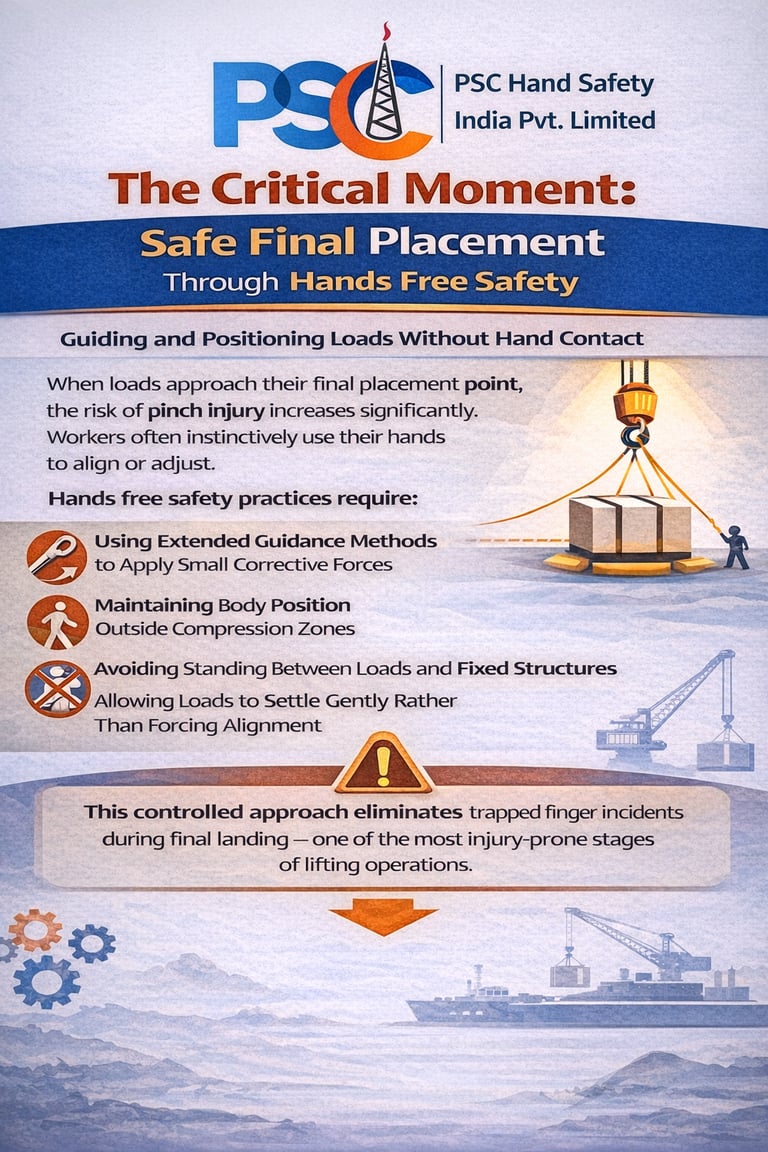
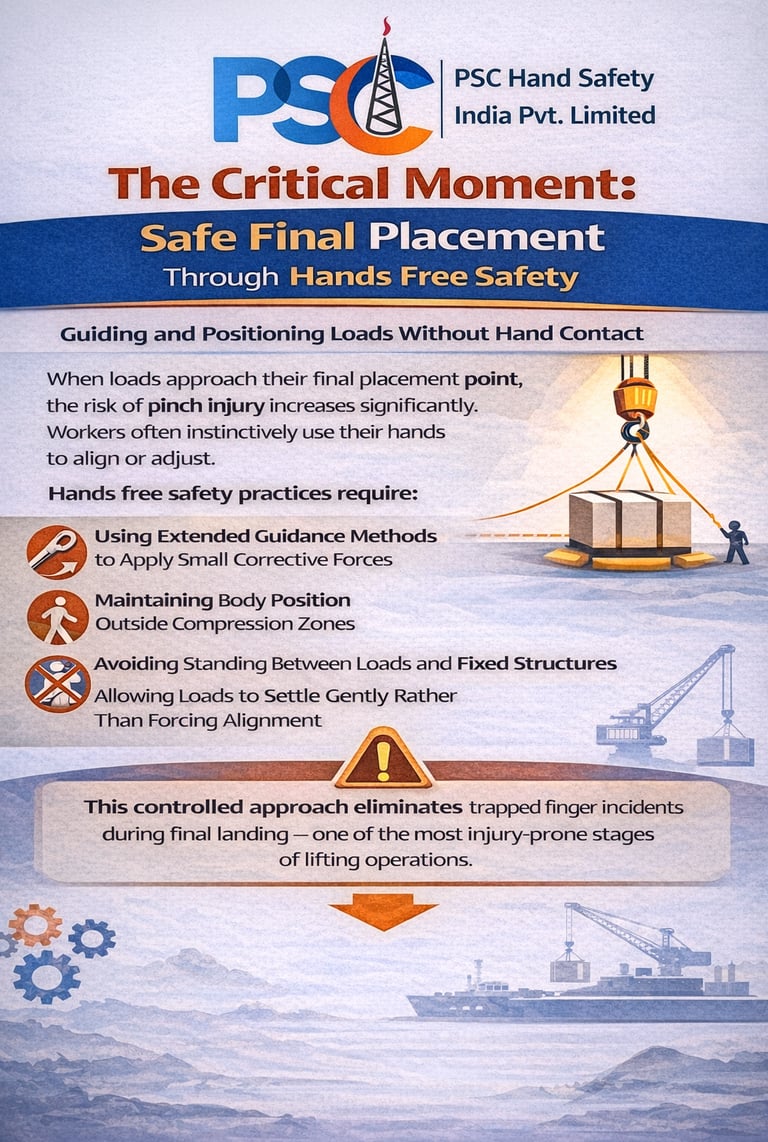
• Using extended guidance methods to apply small corrective forces
• Maintaining body position outside compression zones
• Avoiding standing between loads and fixed structures
• Allowing loads to settle gently rather than forcing alignment
This controlled approach eliminates trapped finger incidents during final landing — one of the most injury-prone stages of lifting operations.
Hands Free Safety and Caught-Between Hazard Prevention
Engineering Out Compression Zone Exposure
Caught-between incidents typically occur when workers position themselves between moving loads and structural elements.
PSC Hands-Free Safety Tools methodology reduces these risks by:
• Establishing clearly marked exclusion or “red zones”
• Prohibiting personnel from entering load drop zones
• Using long-reach positioning methods instead of manual alignment
• Ensuring constant communication between operators and equipment handlers
By redesigning the workflow using hands free safety principles, human presence is removed from compression areas, significantly reducing severe injury risk.
Integrating Hands Free Safety into Ergonomic Manual Handling
Reducing Strain During Pipe, Cylinder & Hose Handling
Hands free safety is not only about impact prevention — it also improves ergonomic performance.
When lifting pipes, cylinders, or hoses:
• Neutral wrist alignment reduces strain injuries
• Loads are kept closer to the body’s center of gravity
• Twisting and bending motions are minimized
• Grip-related fatigue is reduced
By applying hands free safety techniques, the risk of musculoskeletal disorders, repetitive strain injuries, and long-term joint damage is significantly lowered.
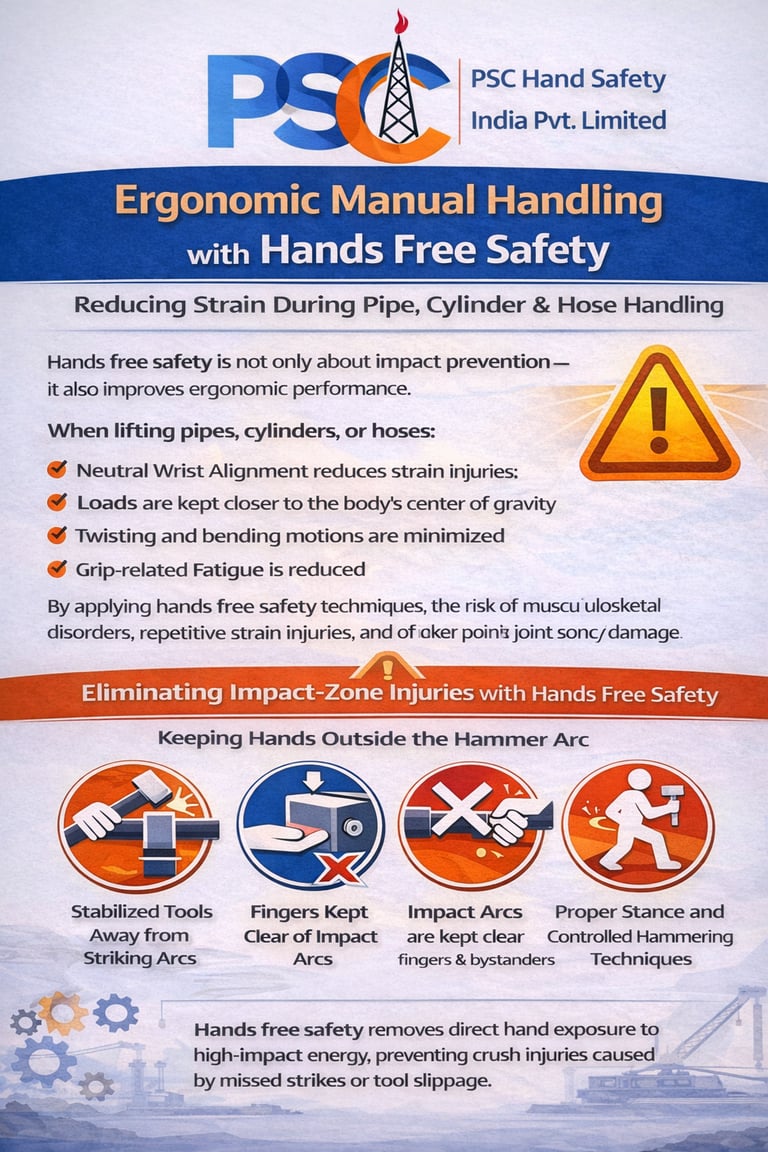
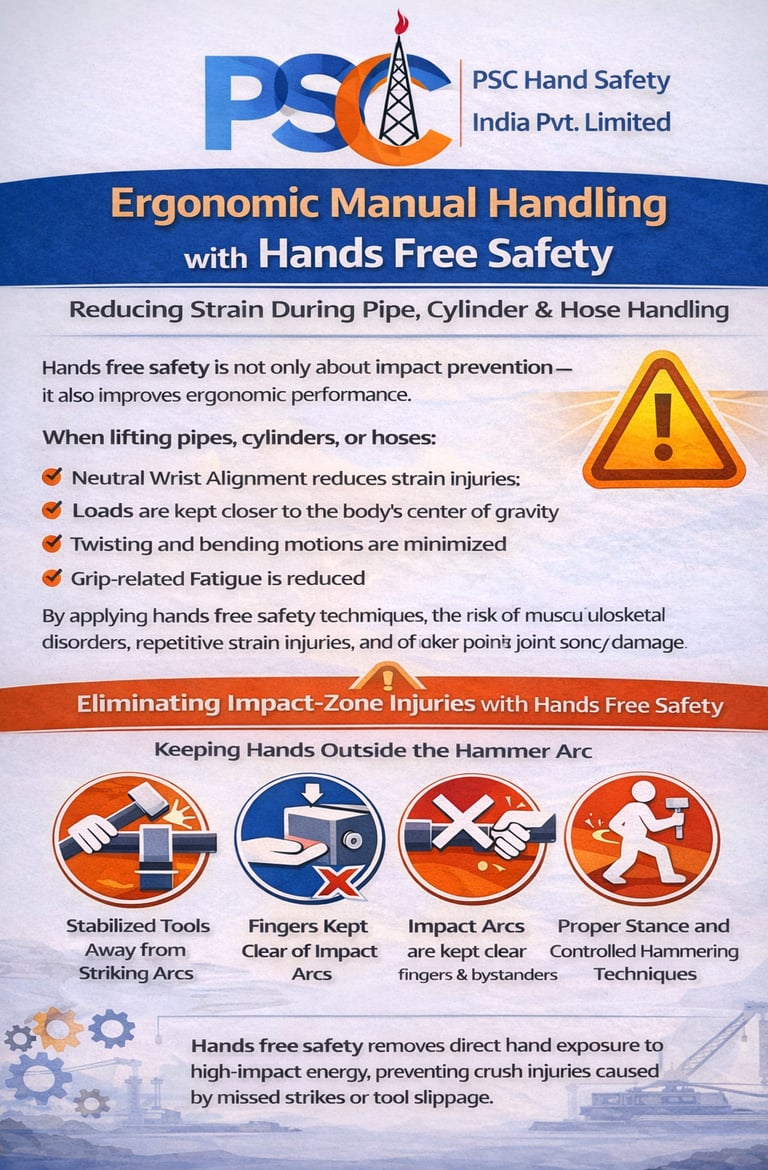
Eliminating Impact-Zone Injuries with Hands Free Safety
Keeping Hands Outside the Hammer Arc
During chiseling or hammering operations, hands are often positioned dangerously close to impact zones.
Hands free safety ensures:Tools are stabilized without direct hand placement near striking areas
• Impact arcs are kept clear of fingers and bystanders
• Proper stance and controlled hammering techniques are applied
Hands free safety removes direct hand exposure to high-impact energy, preventing crush injuries caused by missed strikes or tool slippage.
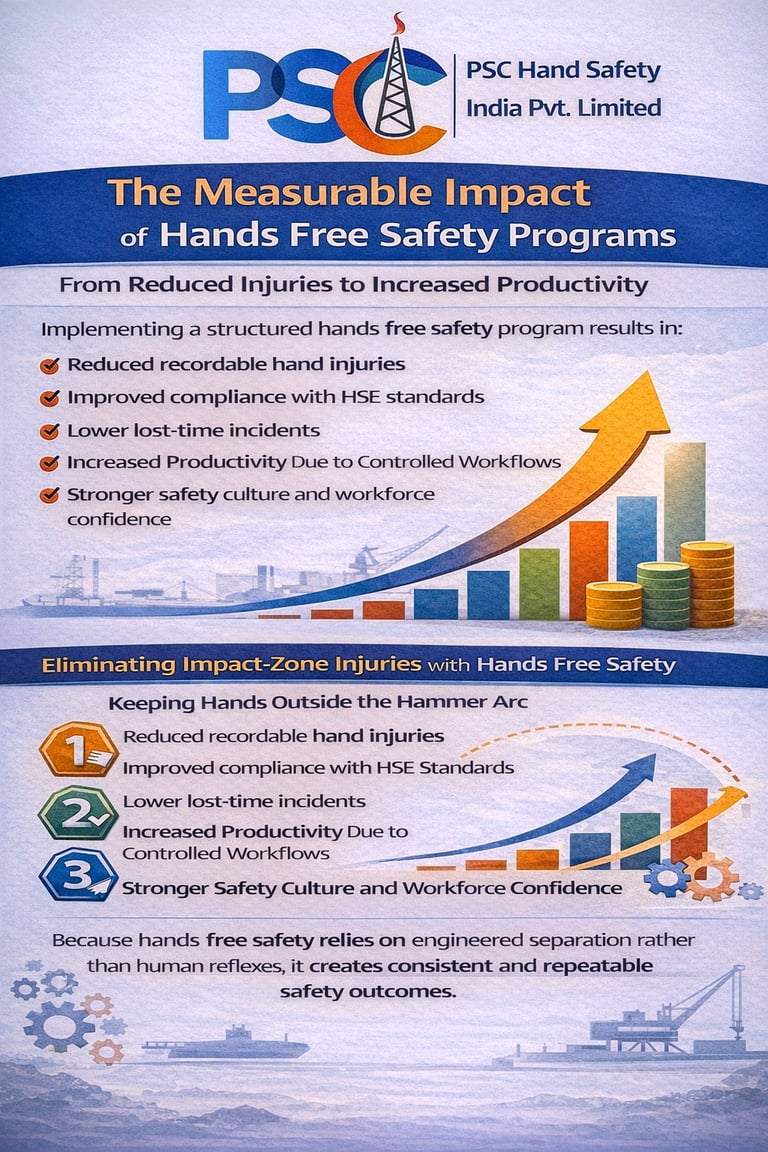
The Measurable Impact of Hands Free Safety Programs
From Reduced Injuries to Increased Productivity
Implementing a structured hands free safety program results in:
• Reduced recordable hand injuries
• Improved compliance with HSE standards
• Lower lost-time incidents
• Increased productivity due to controlled workflows
• Stronger safety culture and workforce confidence
Because hands free safety relies on engineered separation rather than human reflexes, it creates consistent and repeatable safety outcomes.
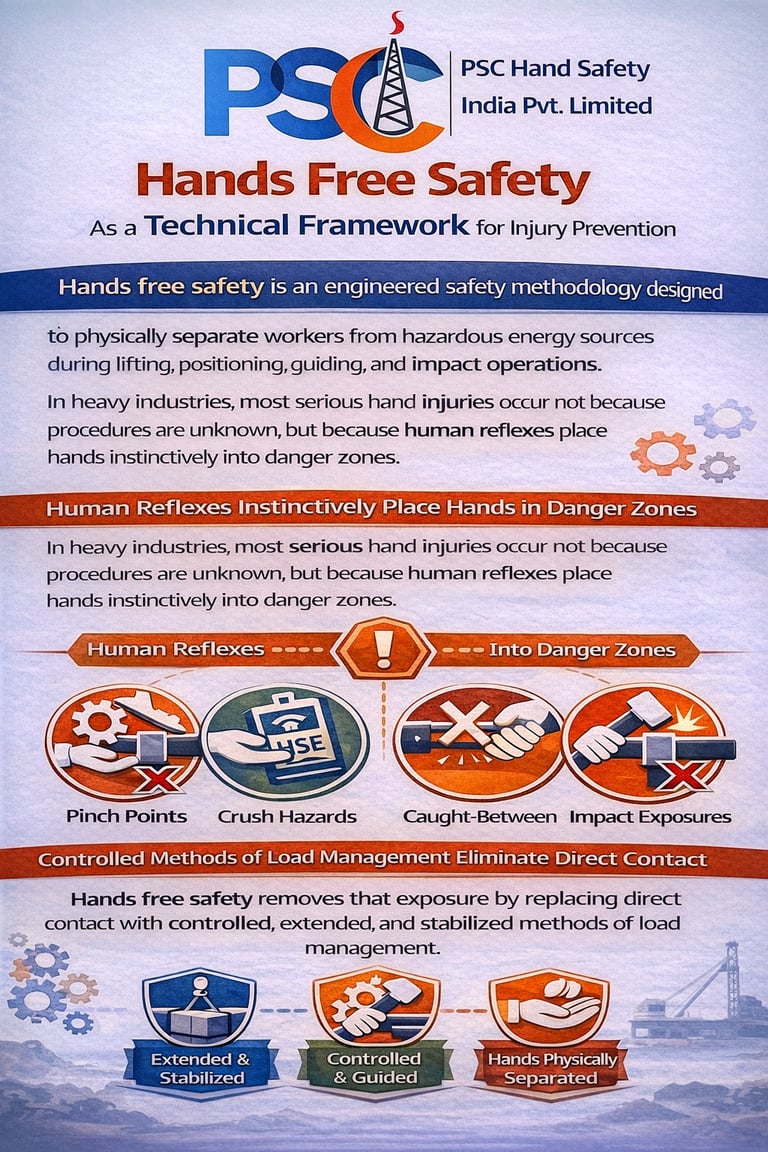
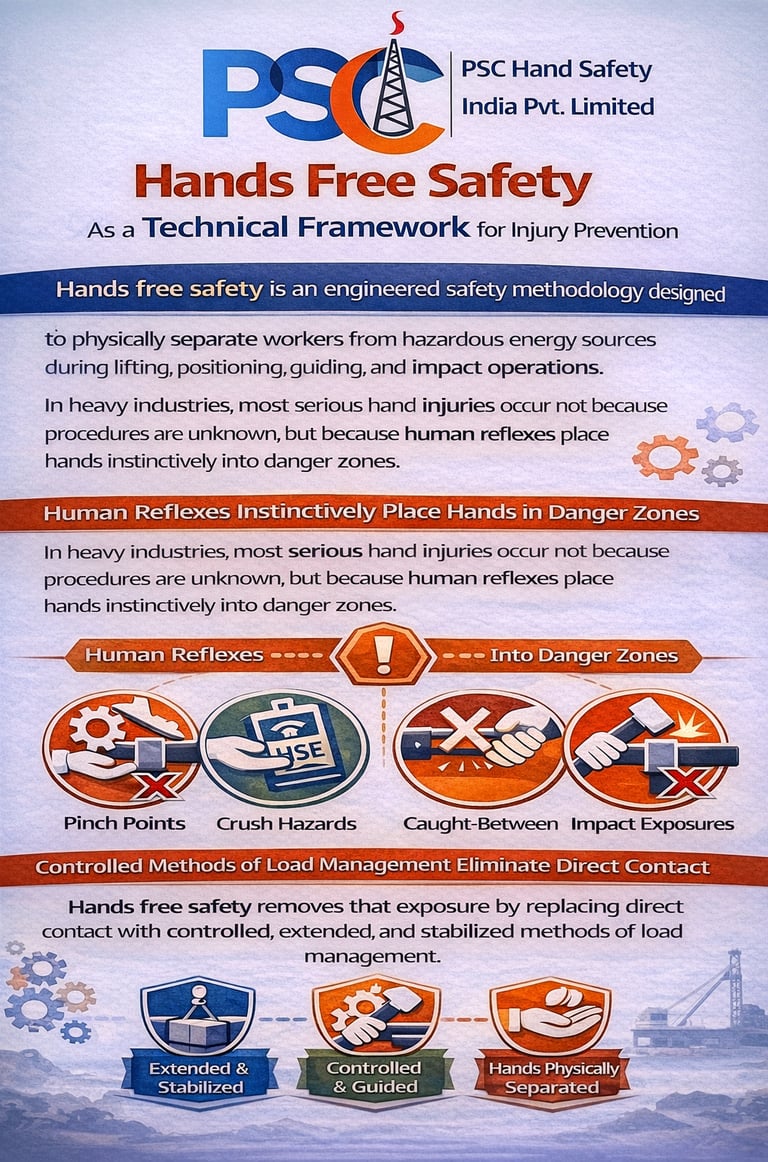
Hands Free Safety as a Technical Framework for Injury Prevention
PSC Hands-free safety tools is an engineered safety methodology designed to physically separate workers from hazardous energy sources during lifting, positioning, guiding, and impact operations. In heavy industries, most serious hand injuries occur not because procedures are unknown, but because human reflexes place hands instinctively into danger zones.
PSC Hands-free safety tools safety removes that exposure by replacing direct contact with controlled, extended, and stabilized methods of load management.
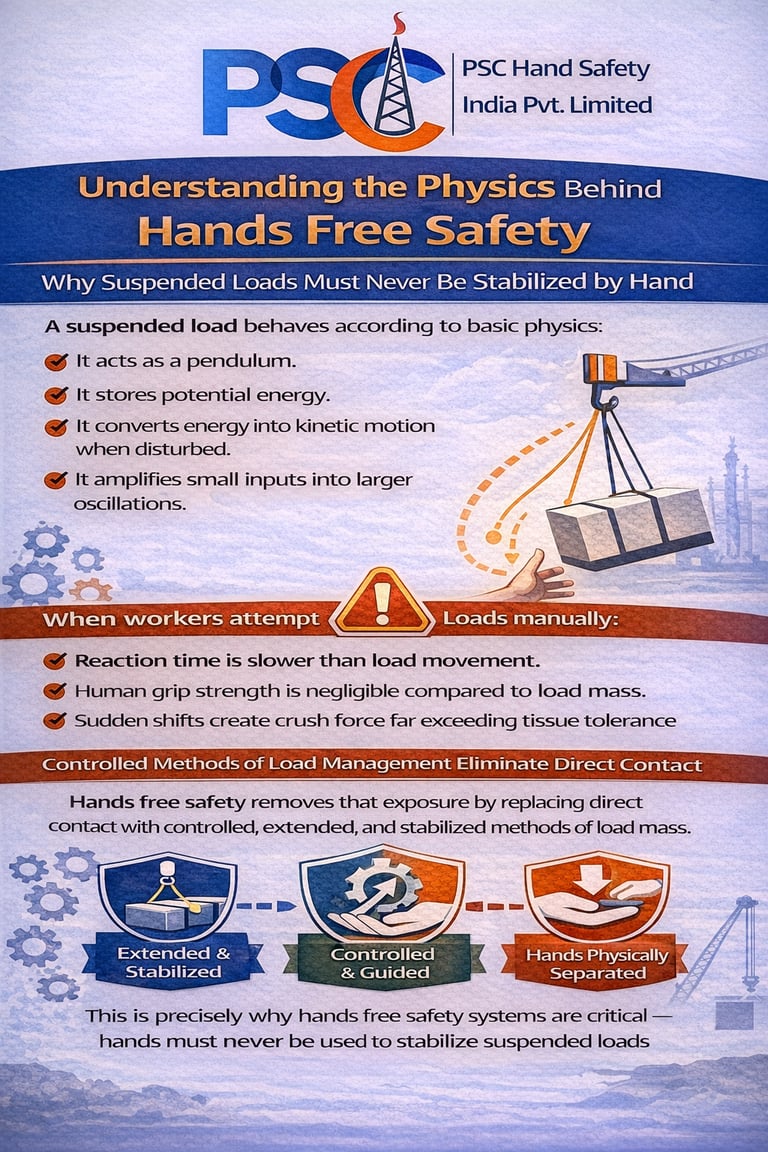
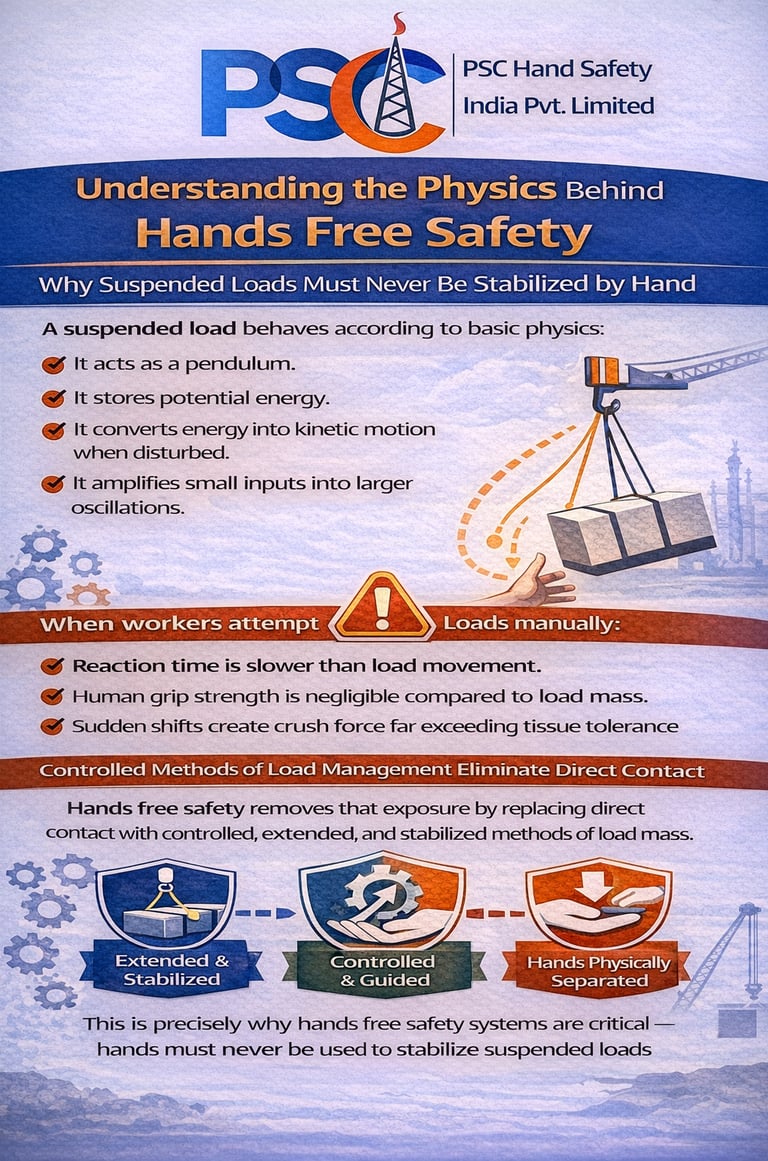
Understanding the Physics Behind Hands Free Safety
Why Suspended Loads Must Never Be Stabilized by Hand
A suspended load behaves according to basic physics:
• It acts as a pendulum.
• It stores potential energy.
• It converts energy into kinetic motion when disturbed.
• It amplifies small inputs into larger oscillations.
When workers attempt to stabilize loads manually:
• Reaction time is slower than load movement.
• Human grip strength is negligible compared to load mass.
• Sudden shifts create crush force far exceeding tissue tolerance.
This is precisely why hands free safety systems are critical — hands must never be used to stabilize suspended loads directly.
The Future of Industrial Safety Is Hands-Free Safety
Hands free safety is a systematic, engineering-driven approach to managing suspended loads and high-risk manual operations. By increasing standoff distance, controlling load motion, stabilizing swing, improving ergonomics, and eliminating direct hand exposure to impact zones, hands free safety significantly reduces pinch, crush, and caught-between injuries.
Hands free safety is not simply a change in tools — it is a transformation in how work is performed. When workers are physically separated from hazardous energy, the workplace becomes safer, more controlled, disciplined, and efficient.
Solution: PSC Hands-Free Safety Tools
We supply the complete range of PSC Hands-Free and Hands-Off Safety Tools, engineered to eliminate hand and finger injuries in high-risk industrial environments.PSC Hands-free safety tools are purpose-built to keep hands away from suspended loads, pinch points, crush zones, impact areas, and moving equipment.
Designed for oil & gas, heavy lifting, fabrication, construction, power plants, and industrial maintenance, PSC tools improve compliance, enhance operational control, and significantly reduce recordable hand injuries.
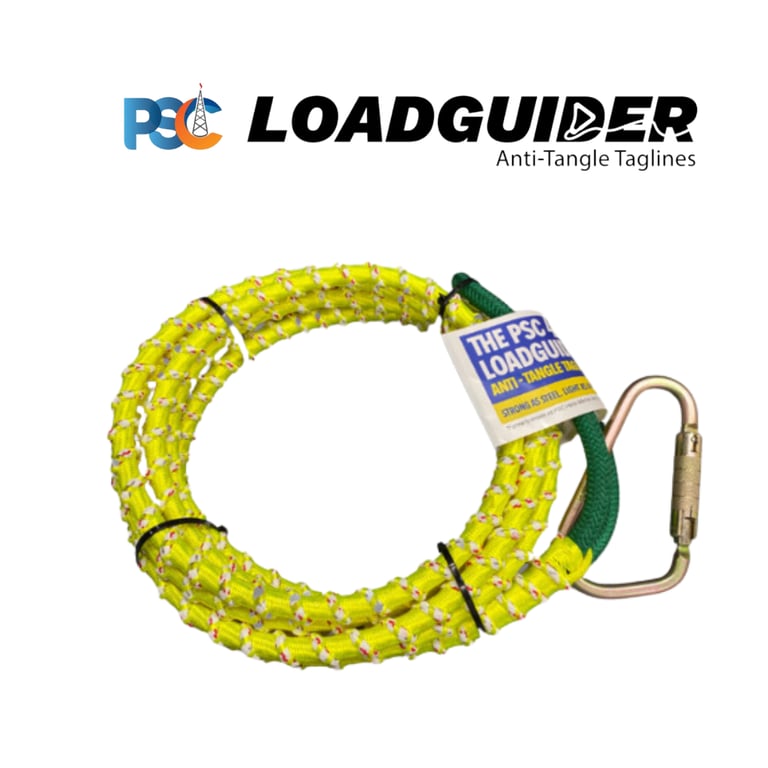
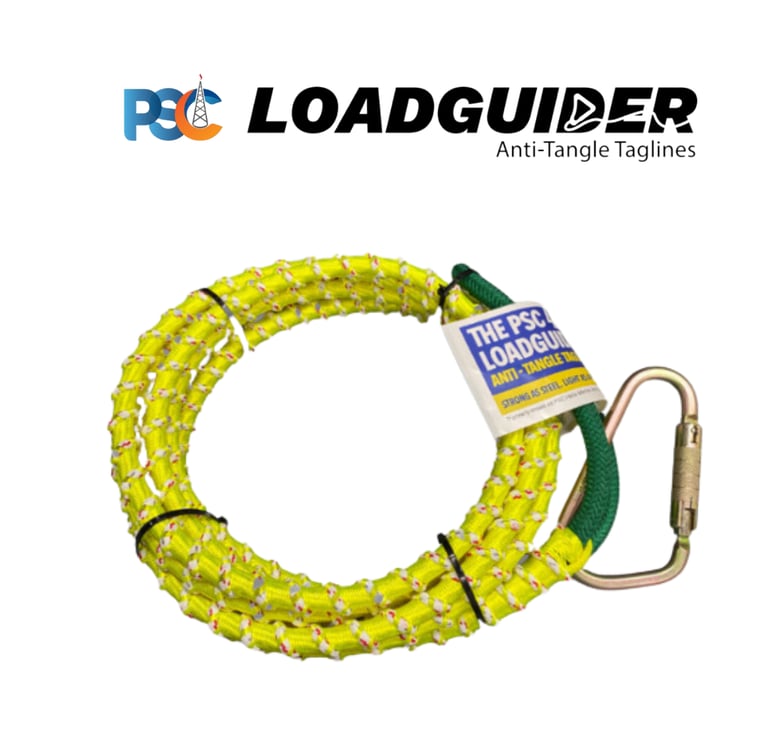
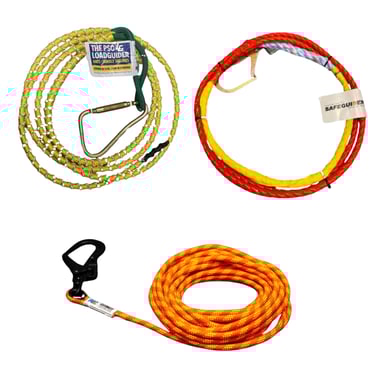
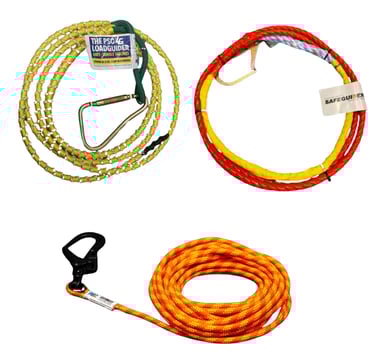
1. PSC LoadGuider Anti-Tangle Tagline - Hands-Free Safety Tool
The PSC LoadGuider Anti-Tangle Tagline is designed to provide safe and controlled guidance of suspended loads during lifting and landing operations. Its anti-tangle construction minimizes rope twisting and knot formation, ensuring predictable load movement. This tagline allows operators to manage swing, rotation, and positioning from a safe working distance. It is ideal for crane lifts, offshore rigs, and heavy lifting zones where load stability is critical.
Key Features:
• Anti-tangle engineered rope design
• High durability under repetitive use
• Improves controlled load positioning
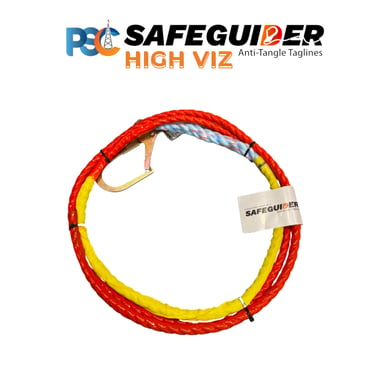
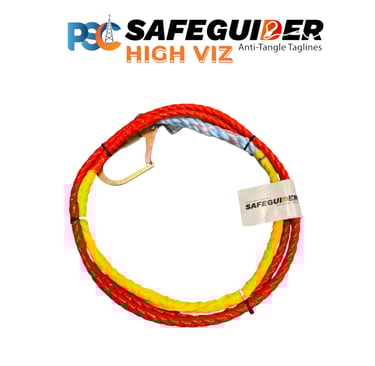
2. PSC SafeGuider High-Visibility Anti-Tangle Tagline - Hands-Free Safety Tool
The PSC SafeGuider High-Visibility Anti-Tangle Tagline enhances operator visibility while providing superior load control. Manufactured using high-visibility materials, it improves safety in low-light or complex work areas. Its anti-twist properties reduce unexpected rope binding and allow smoother rotation control during suspended load operations.
Key Features:
• High-visibility safety material
• Reduced rope twisting and snagging
• Improved directional control
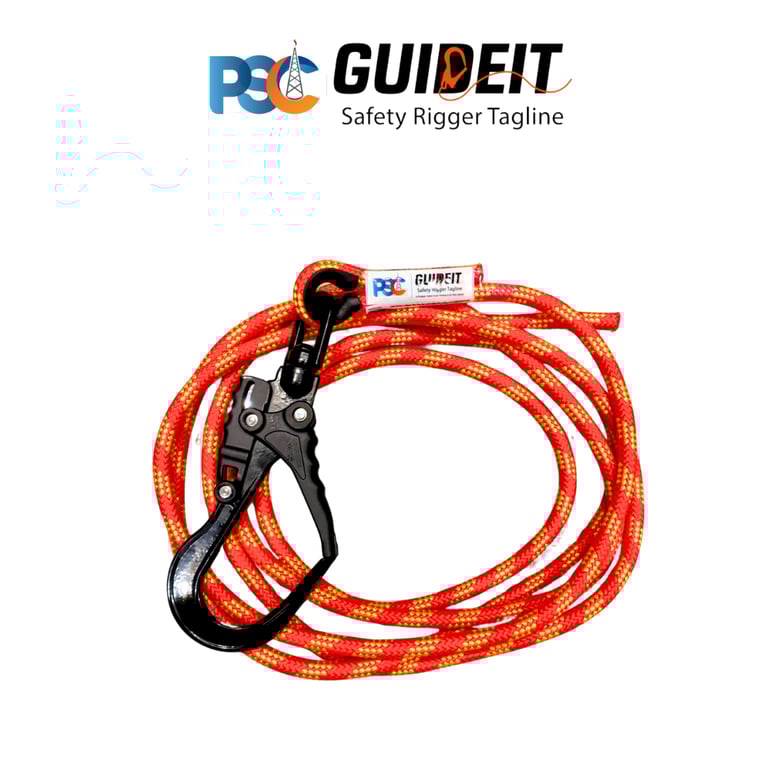
3. PSC Guide-It Safety Rigger Tagline - Hands-Free Safety Tool
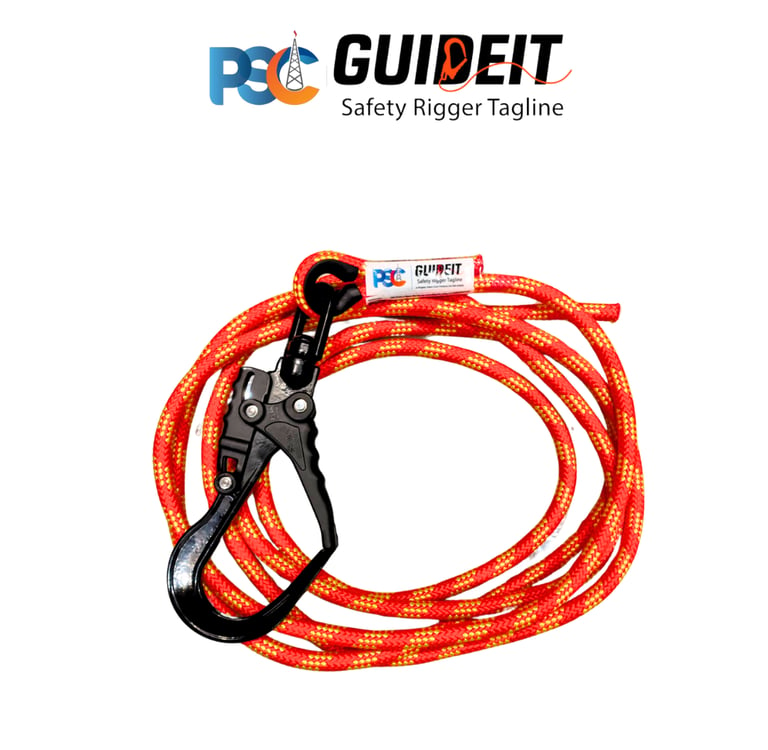
The PSC Guide-It Safety Rigger Tagline is a professional-grade rigging tagline equipped with a swivel hook and safety latch. The swivel mechanism allows controlled rotation while preventing rope twisting. Designed for demanding industrial lifting operations, it provides dependable guidance during load lowering and positioning.
Key Features:
• Swivel hook with secure latch
• Durable polyester rope construction
• Suitable for heavy rigging environments
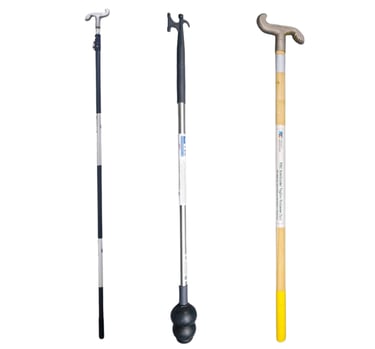
4. PSC Tagline Retriever Tool (TRT) - Hands-Free Safety Tool
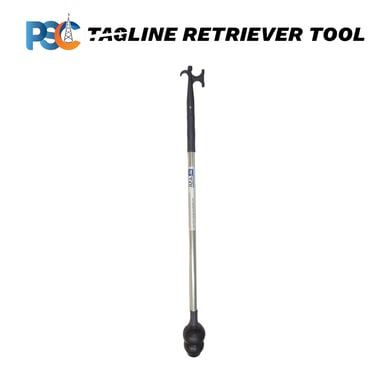
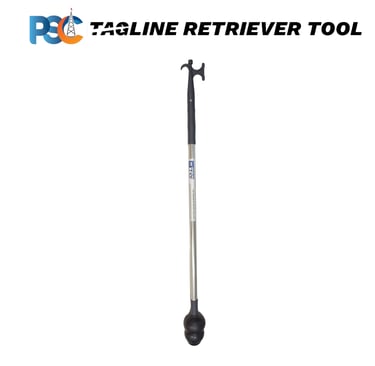
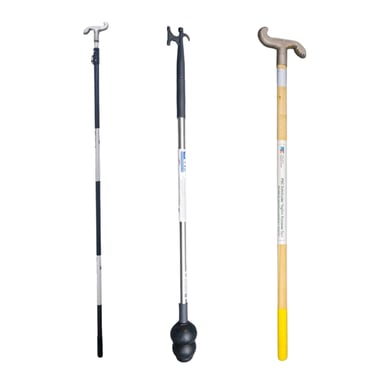
The PSC Tagline Retriever Tool (TRT) enables safe retrieval of taglines without requiring workers to step into hazardous zones. Featuring a telescopic aluminum hook and rubber buffer end, it allows safe tagline capture and repositioning. It also assists in gently pushing suspended loads into position during landing.
Key Features:
• Telescopic reach design
• Safe tagline capture from distance
• Dual function – retrieval and guidance
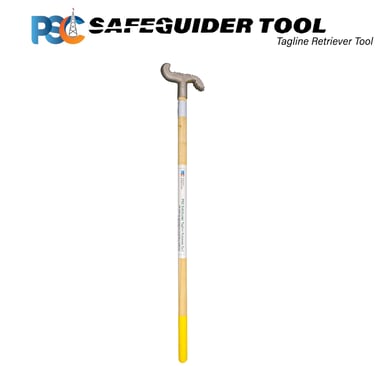
5. PSC SafeGuider Tagline Retriever Tool - Hands-Free Safety Tool
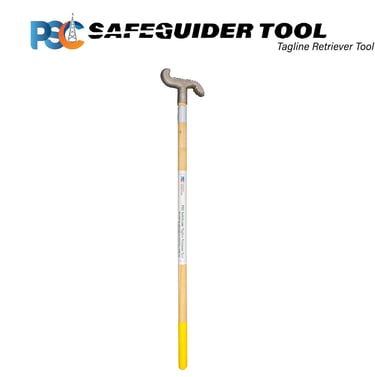
The PSC SafeGuider Tagline Retriever Tool combines tagline retrieval and push/pull assistance in one versatile tool. It allows workers to control loads and recover ropes without direct contact. Its lightweight construction ensures ease of handling while maintaining structural strength in industrial conditions.
Key Features:
• Multi-functional safety tool
• Durable head construction
• Reduces red-zone exposure
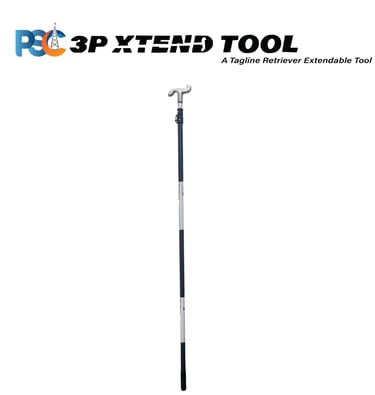
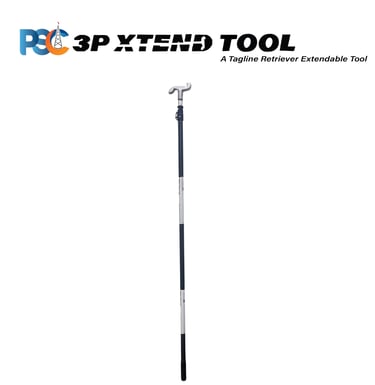
6. PSC 3P-Xtend Tagline Retriever Tool - Hands-Free Safety Tool
The PSC 3P-Xtend Tagline Retriever Tool is an extendable hands-free device that provides adjustable reach for different lifting scenarios. It can be extended incrementally to suit job site requirements and collapsed for storage or push/pull use. This versatility makes it highly effective for complex lifting environments.
Key Features:
• Adjustable telescopic extension
• Secure locking mechanism
• Suitable for multiple load heights
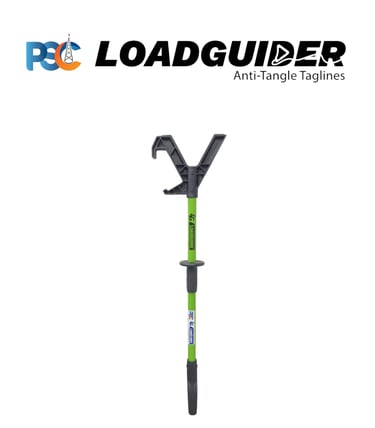
7. PSC LoadGuider Push/Pull Tool - Hands-Free Safety Tool
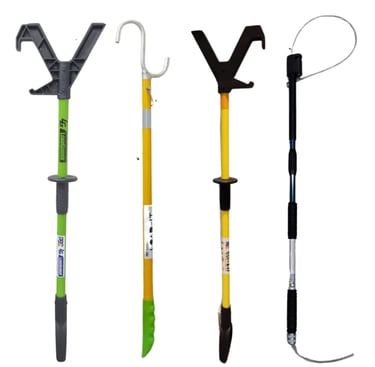
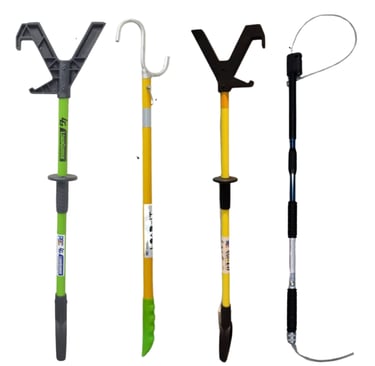
The PSC LoadGuider Push/Pull Tool is engineered for safe maneuvering of suspended loads, equipment, and tubulars. Constructed from strong yet lightweight materials, it allows operators to push or pull loads while keeping hands safely outside pinch and crush zones. It enhances control during final load placement.
Key Features:
• Lightweight fiberglass construction
• Durable load contact head
• Reduces wrist strain and injury risk
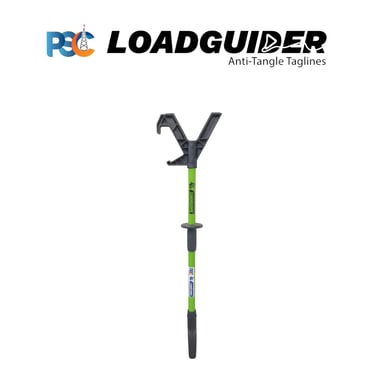
8. PSC Guide-It Push/Pull Tool - Hands-Free Safety Tool
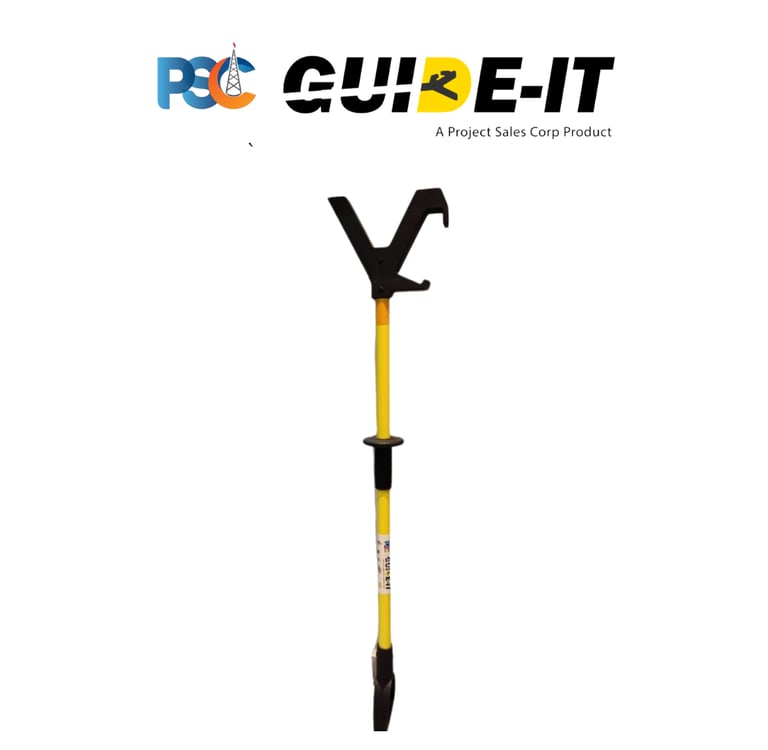
The PSC Guide-It Push/Pull Tool provides controlled load maneuvering for drill pipes, sling legs, and rigging components. Its ergonomic design ensures better leverage and stability during suspended load guidance. It helps maintain safe operator distance in high-risk lifting areas.
Key Features:
• Ergonomic grip design
• Improved load positioning accuracy
• Suitable for tubular handling
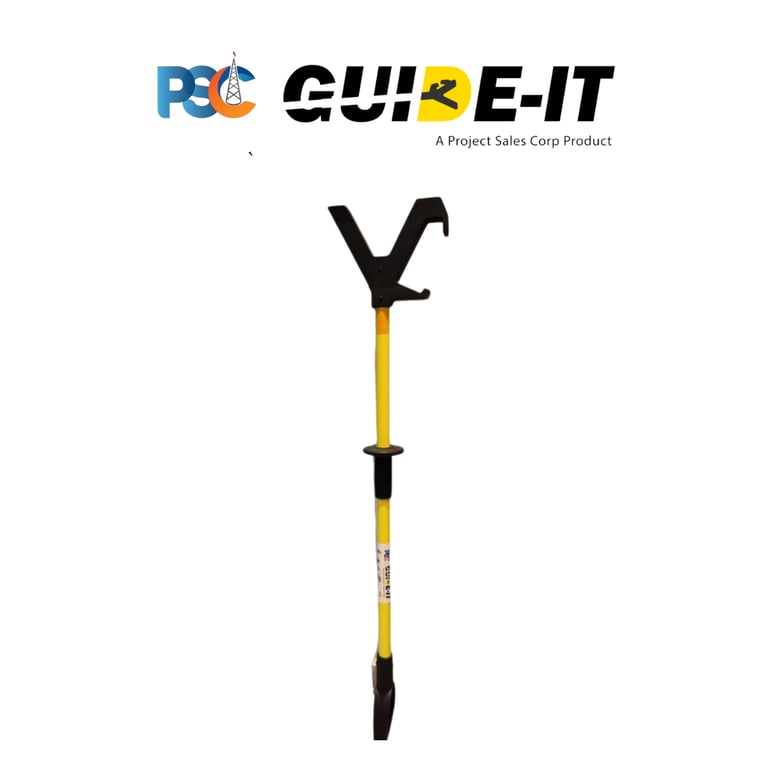
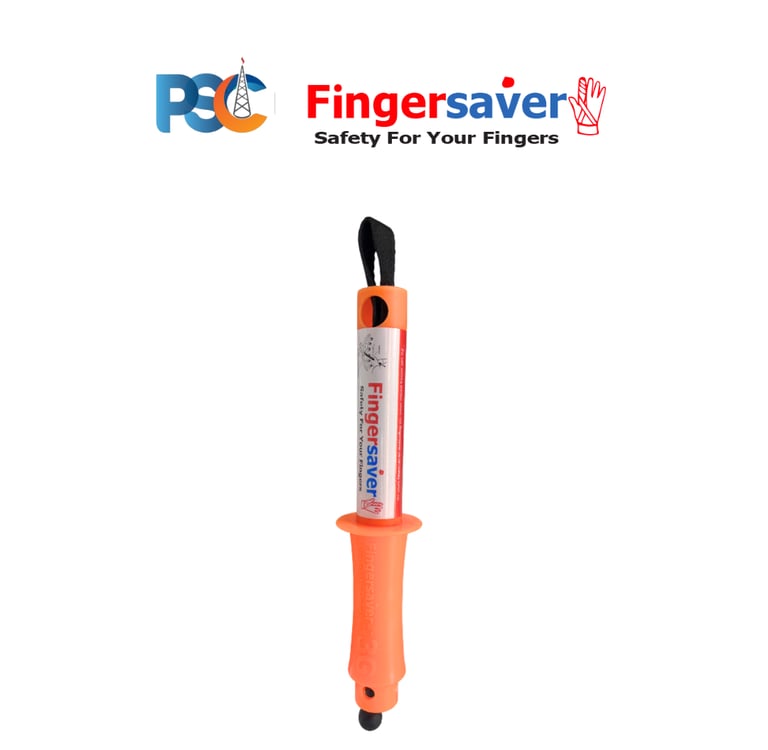
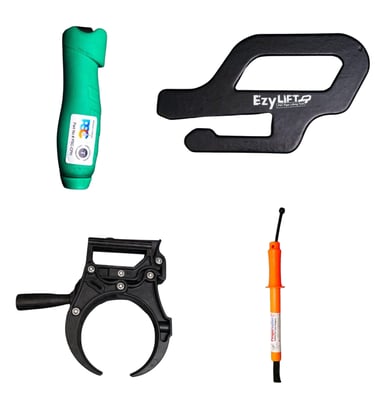
9. PSC FingerSaver Impact Protection Tool - Hands-Free Safety Tool
The PSC FingerSaver Impact Protection Tool protects hands during hammering and striking operations involving flogging spanners. It stabilizes the wrench while keeping hands away from the striking zone. This significantly reduces crush injuries and accidental impact damage.
Key Features:
• Prevents hammer impact injuries
• Compatible with multiple spanner sizes
• Improves striking stability
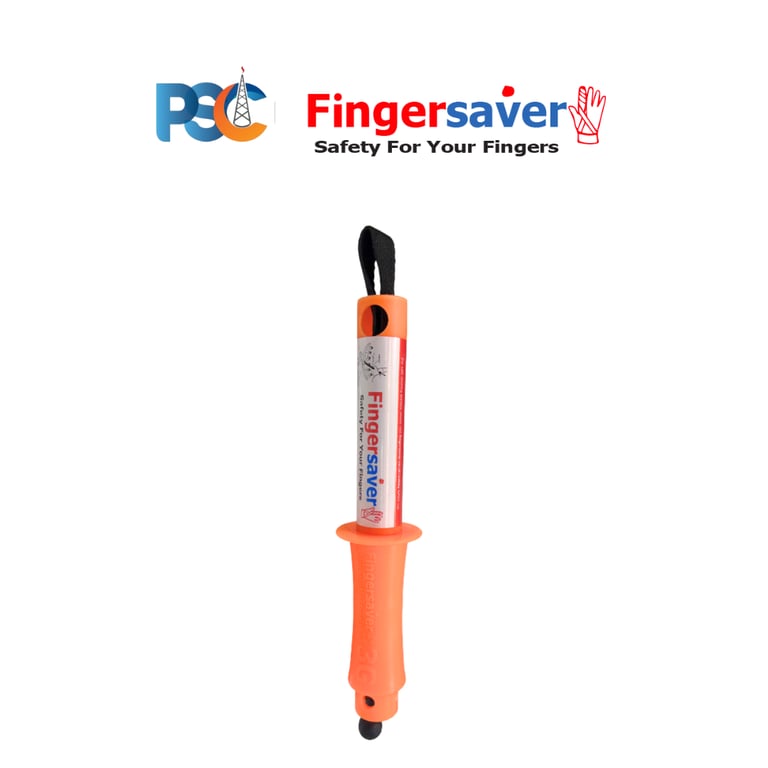
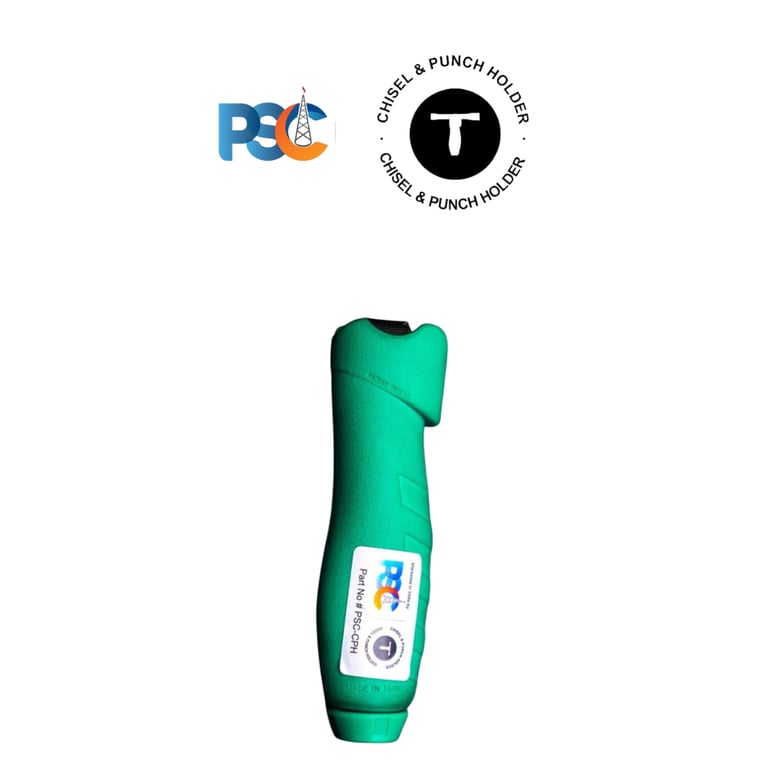
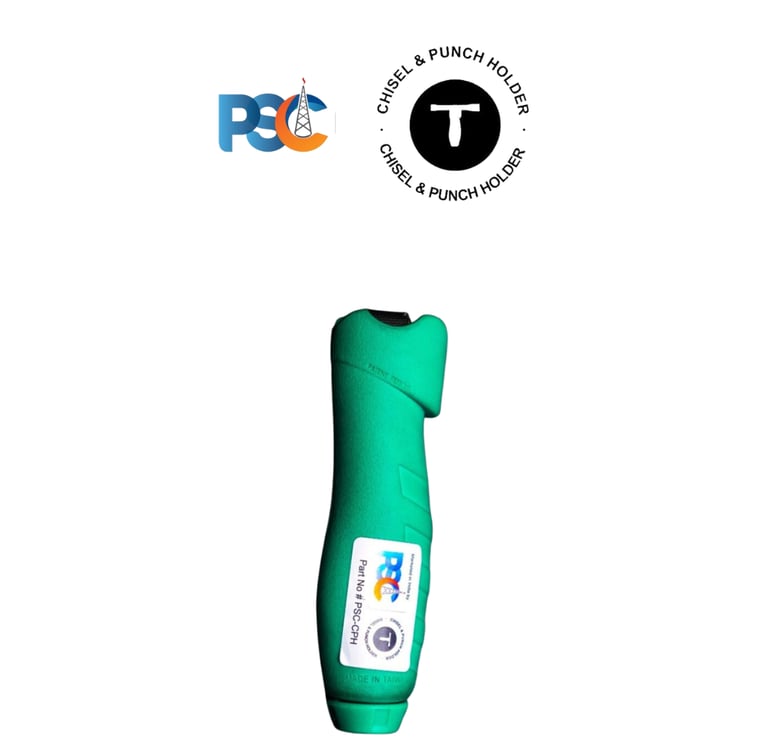
10. PSC Chisel & Punch Holder Tool - Hands-Free Safety Tool
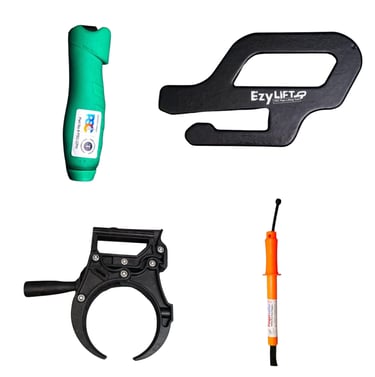
The PSC Chisel & Punch Holder Tool eliminates the need to manually hold chisels and punches during striking tasks. Its secure gripping mechanism keeps the tool stable while protecting hands from accidental blows. It is widely used in fabrication and mechanical maintenance environments.
Key Features:
• Hands-off striking solution
• Secure tool stabilization
• Reduces finger injuries
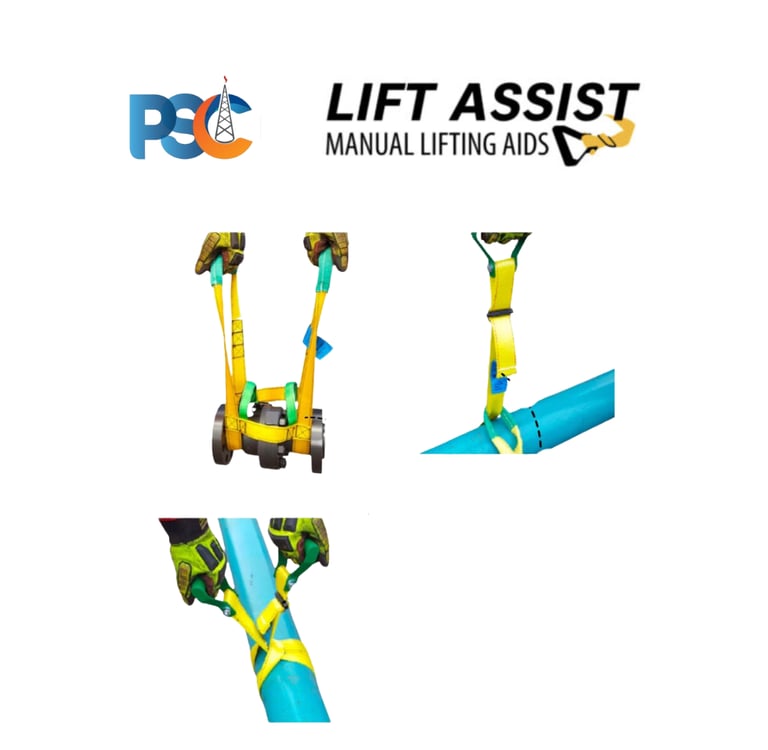
11. PSC Lift Assist Manual Lifting Aid - Hands-Free Safety Tool
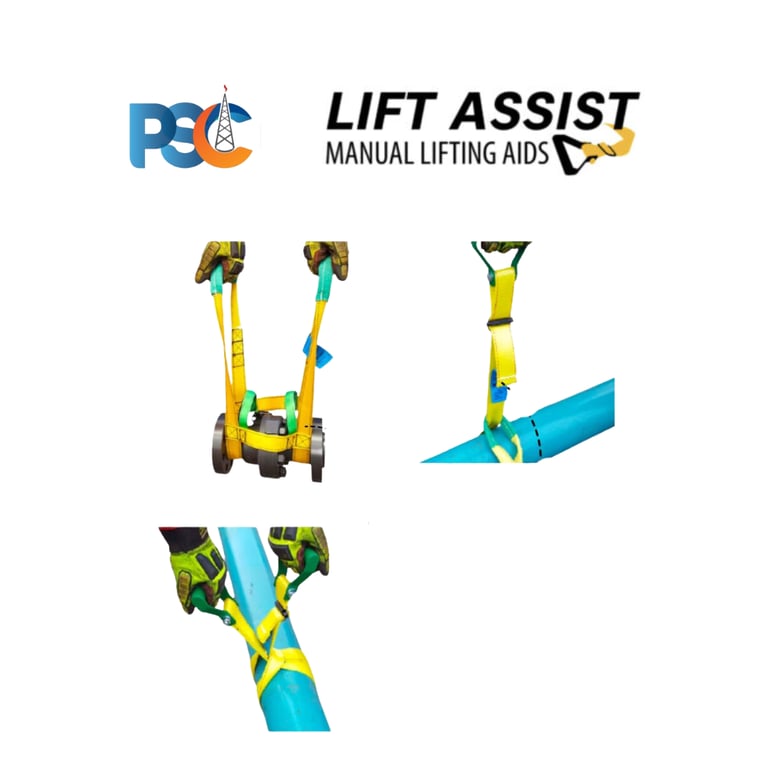
The PSC Lift Assist Manual Lifting Aid improves manual lifting posture and reduces strain on wrists and fingers. It promotes safer ergonomic lifting techniques for smaller loads and components. This tool enhances worker comfort while reducing repetitive strain injuries.
Key Features:
• Improves lifting ergonomics
• Reduces strain and fatigue
• Lightweight and easy to use
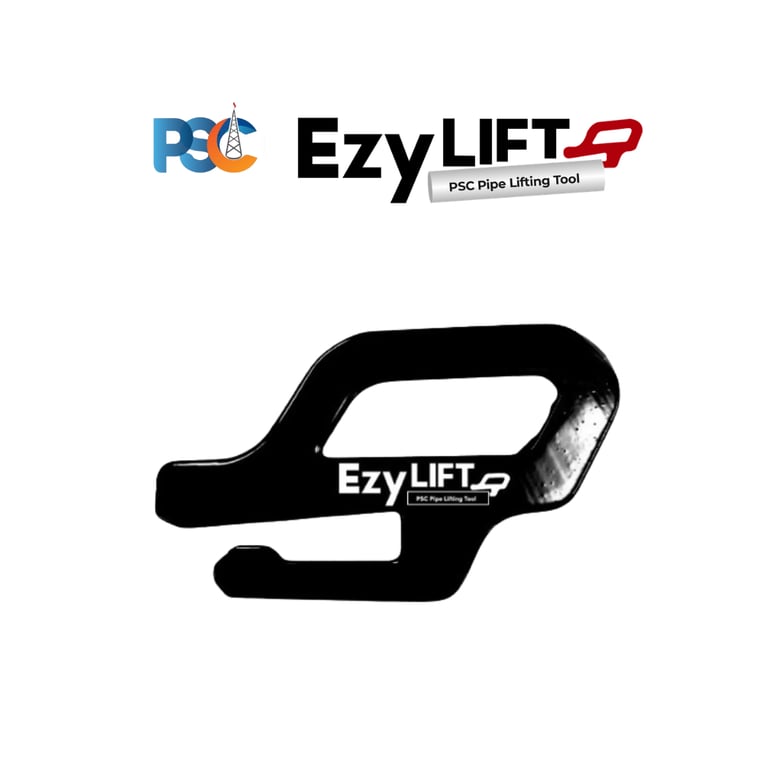
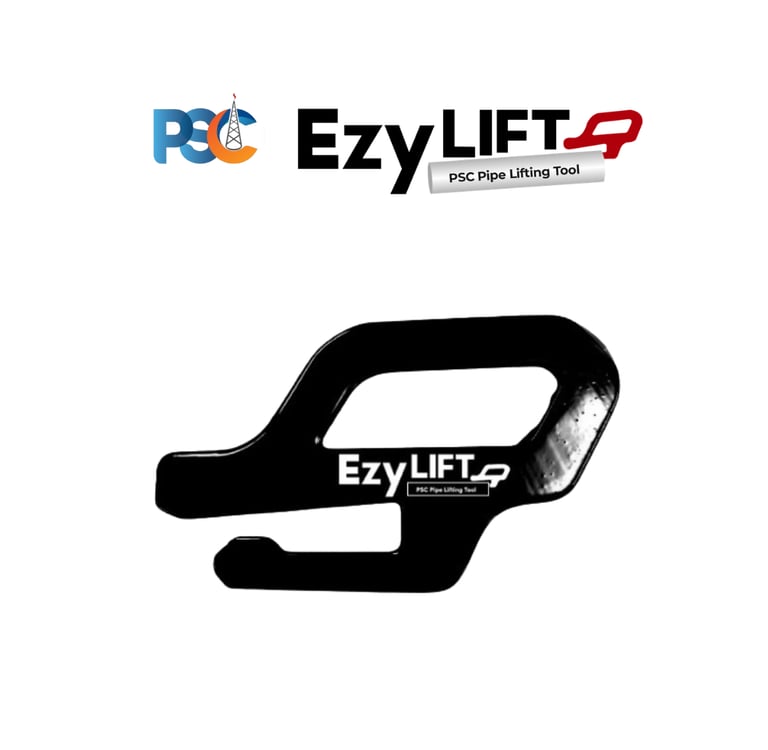
12. PSC Ezy-Lift Pipe Lifting Tool - Hands-Free Safety Tool
The PSC Ezy-Lift Pipe Lifting Tool enables safer manual lifting of pipes while maintaining neutral wrist alignment. It minimizes direct contact with pipe surfaces and reduces pinch risks during positioning. This tool is especially useful during pipe installation and maintenance tasks.
Key Features:
• Neutral wrist positioning
• Safer pipe handling
• Reduces hand fatigue
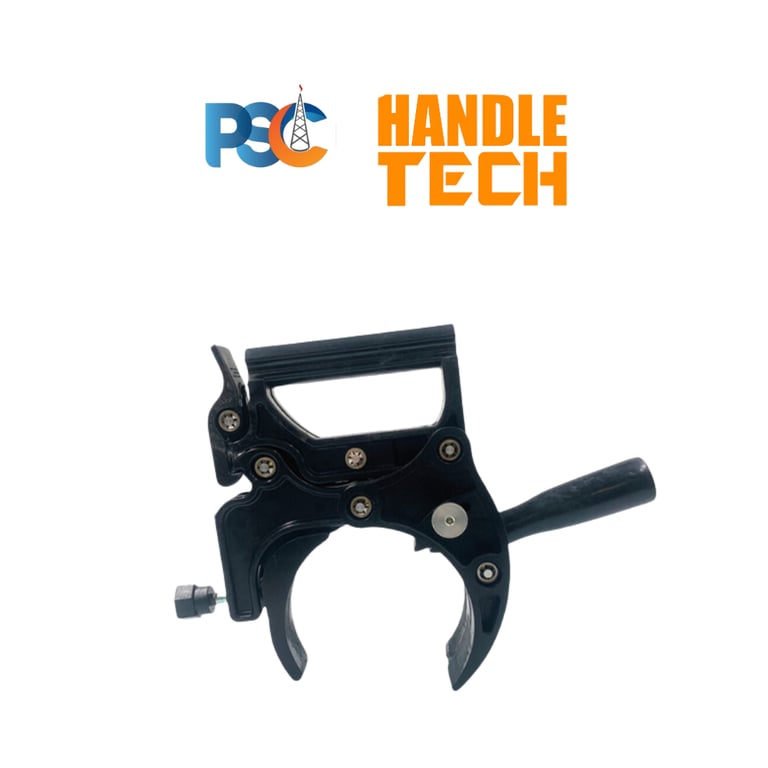
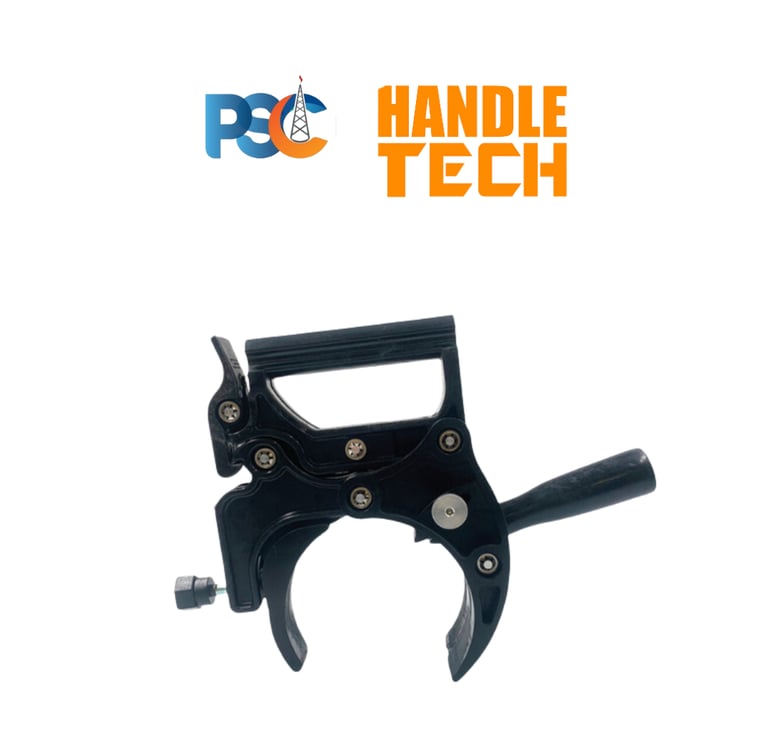
13. PSC Handle-Tech Pipe Handle Tool - Hands-Free Safety Tool
The PSC Handle-Tech Pipe Handle Tool attaches securely to pipes or hoses, transforming awkward loads into manageable carrying positions. It improves load balance and reduces hand strain during transport. This tool enhances control and stability in manual pipe handling operations.
Key Features:
• Secure attachment mechanism
• Improved carrying posture
• Reduces pinch exposure
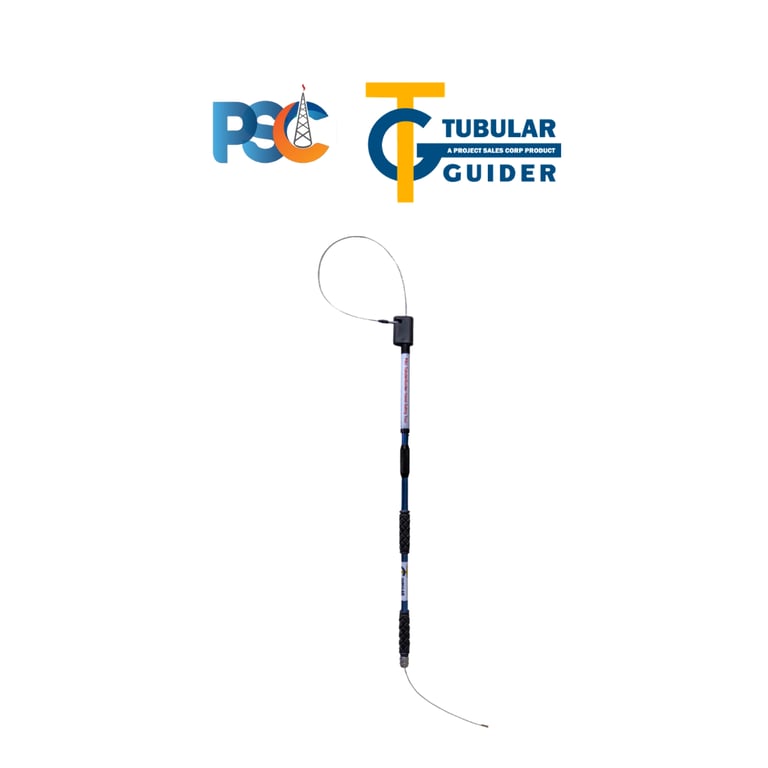
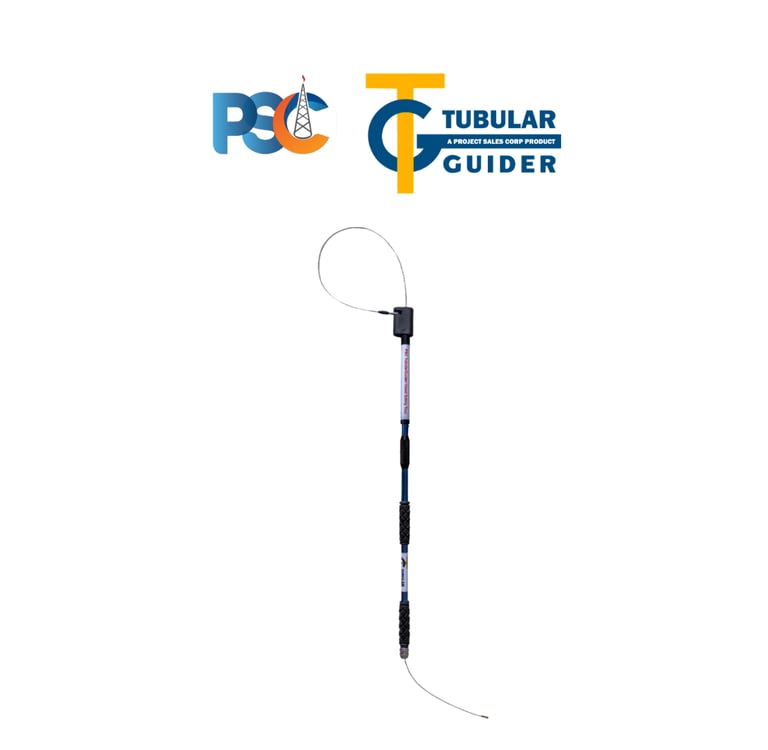
14. PSC TubularGuider Hands-Off Tubular Handling Tool - Hands-Free Safety Tool
The PSC TubularGuider Hands-Off Tubular Handling Tool is designed for guiding and positioning tubulars safely during rigging or storage operations. Featuring non-slip gripping surfaces and a spring-loaded release mechanism, it ensures secure handling while keeping hands clear of dangerous pinch zones.
Key Features:
• Non-slip grip design
• Spring-loaded release system
• Safe tubular positioning
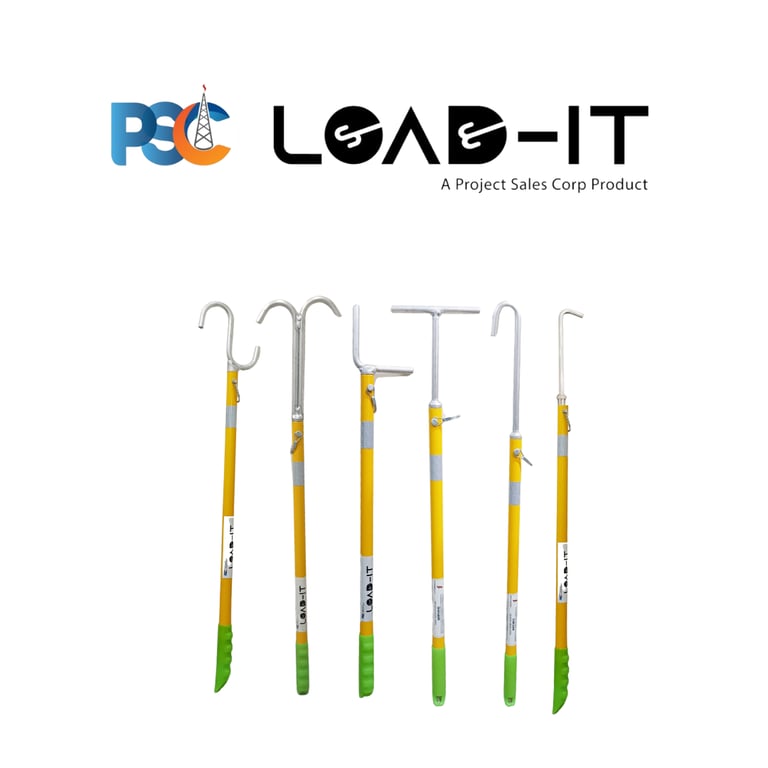
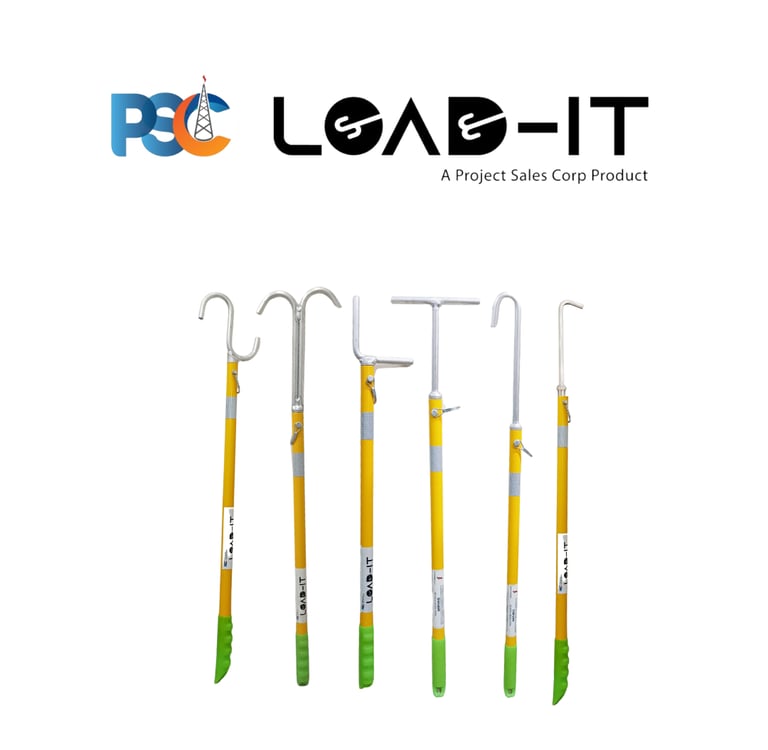
15. PSC Load-It Push Pull Tool - Hands-Free Safety Tool
The Load-It Push Pull Tool is a hands-free load positioning device designed to guide, align, and maneuver heavy materials without direct hand contact. It allows workers to apply controlled force from a safe distance, keeping them outside pinch and crush zones. The tool enhances precision during final placement of pipes, beams, and structural components. It significantly reduces caught-between and finger injuries in lifting operations.
Key Features:
Provides extended reach to maintain safe separation from suspended loads
Enables controlled push, pull, and lateral alignment without entering red zones
Improves ergonomic posture by reducing bending and overreaching
16. PSC Load-It MagHead - Hands-Free Safety Tool
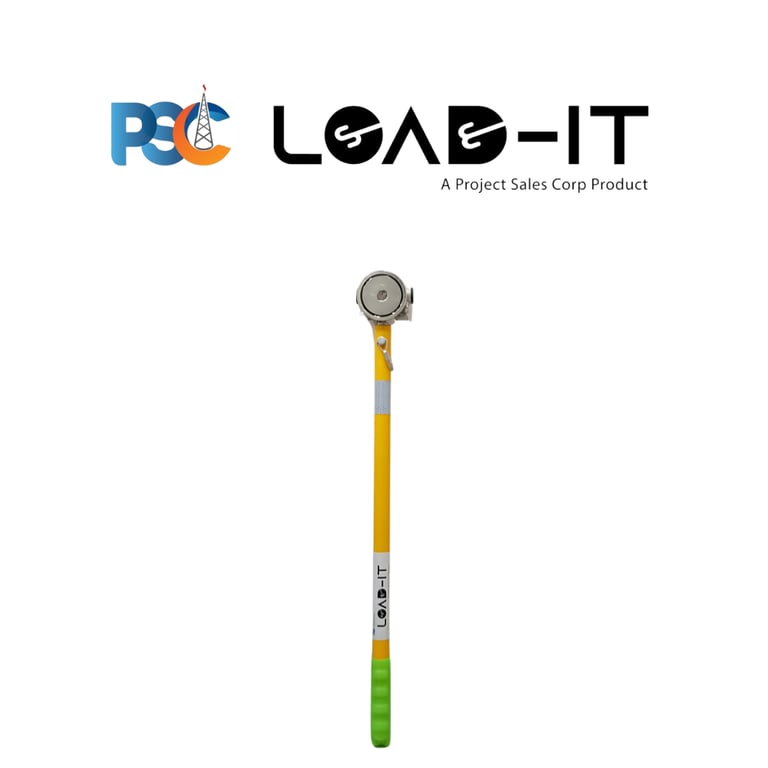
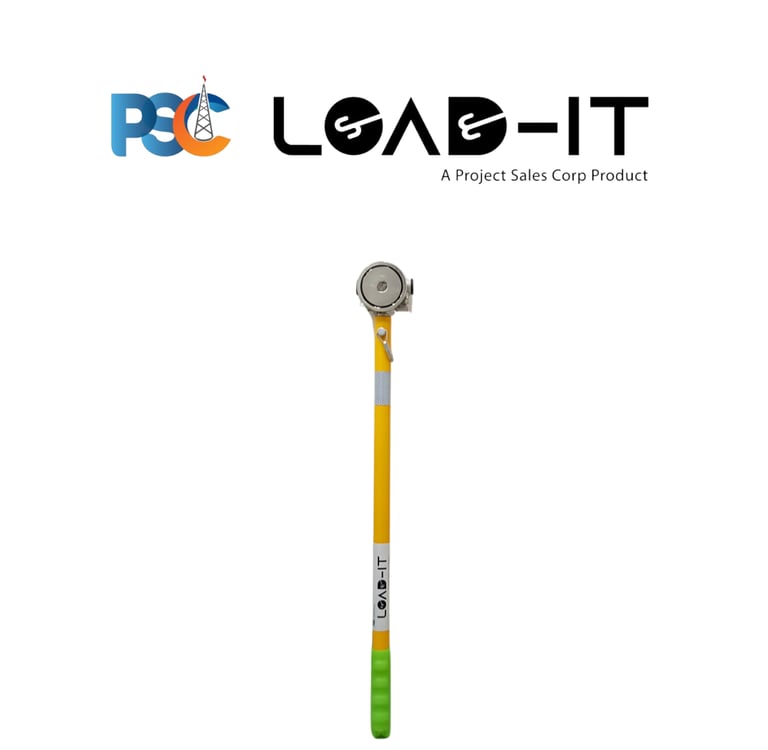
The Load-It MagHead is a magnetic load-control attachment designed for safe handling and positioning of ferrous materials. It allows workers to stabilize and guide steel components without gripping sharp edges or placing hands near impact zones. This method minimizes exposure to pinch points during alignment and installation. It is especially effective in fabrication, structural assembly, and maintenance work.
Key Features:
Magnetic engagement for secure, hands-free contact with metal surfaces
Reduces risk of cuts, crush injuries, and sudden load shifts
Enhances precision alignment while maintaining safe working distance
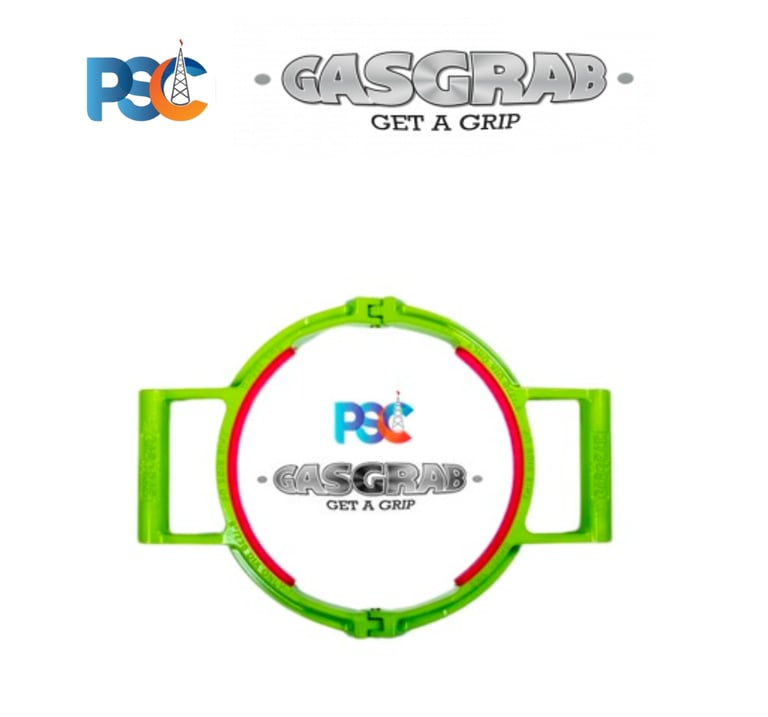
17. PSC Gas Grab - Hands-Free Safety Tool
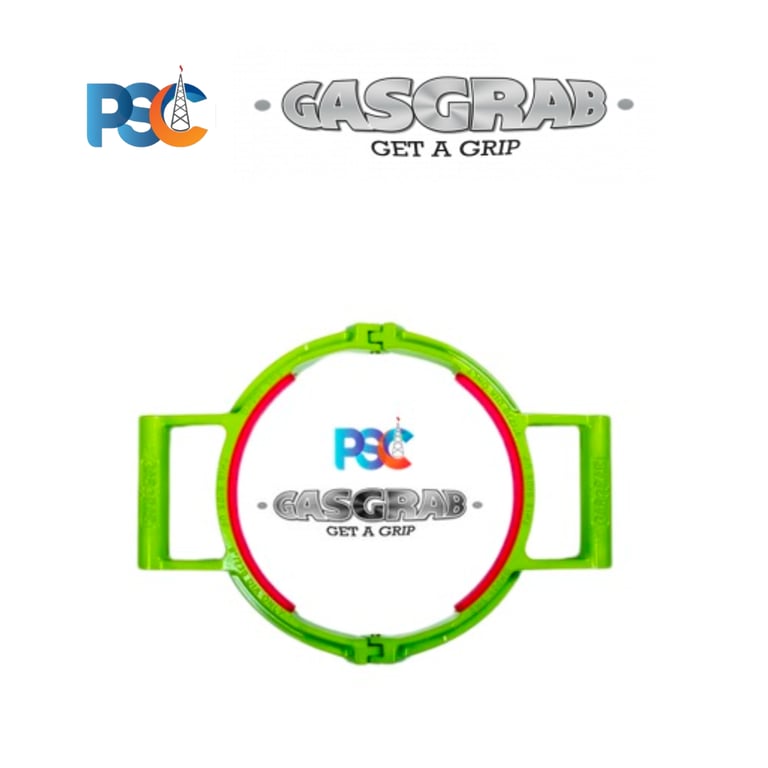
Gas Grab is a hands-free cylinder handling solution designed to safely maneuver gas cylinders without direct hand placement near valve heads or pinch zones. It enables controlled tilting, positioning, and relocation of cylinders while maintaining ergonomic posture. The concept prevents foot crush injuries and hand impact incidents during cylinder movement. It is widely applicable in fabrication shops, oil & gas facilities, and maintenance areas.
Key Features:
Allows controlled movement of cylinders without gripping hazardous points
Minimizes valve damage risk and hand impact exposure
Supports ergonomic handling and reduces manual strain
Our Product Range
Anti-Tangle Taglines & Safety Rigger Lines
PSC Anti-Tangle Taglines provide controlled guidance of suspended loads during crane lifting and landing operations. Their high-visibility, anti-twist construction minimizes rope tangling and unpredictable load movement. These taglines allow workers to stabilize, rotate, and position loads safely from a distance.
PSC Tagline Retriever Tools enable safe recovery of taglines and controlled guidance of suspended loads without entering hazardous red zones. Featuring telescopic reach and secure locking mechanisms, they provide extended working distance. These tools reduce exposure to moving loads and enhance safe lifting practices.
Manual Lifting & Pipe Handling Tools
PSC Manual Lifting and Pipe Handling Tools improve ergonomic posture and reduce strain during lifting and transport of pipes and cylindrical materials. They promote neutral wrist alignment and safer load handling techniques. These tools enhance control, balance, and worker safety in demanding industrial environments.
Push / Pull & Load Guidance Tools
PSC Push/Pull and Load Guidance Tools are designed to safely maneuver suspended loads, tubulars, and heavy equipment without direct hand contact. Made from lightweight yet durable materials, they help operators maintain a safe distance from pinch and crush zones. These tools improve load control, positioning accuracy, and overall site safety during lifting operations.
Tagline Retriever Tools (TRT & Extendable Poles)
Upgrade to PSC Hands-Free Safety Today
📞 Call Us Now: +91 9100932334
📧 Email: info@projectsalescorp.com
🌐 Visit: pschandsfree.com






Dubai Silicon Oasis, Building A1, IFZA Business Park, DDP, Dubai, United Arab Emirates
(+971) 50-457-2844
info@pscdubai.com
pscdubai.com
134 Vintage Park Blvd, Ste A #1006, Houston, TX 77070
(984) 322-1807
info@pschoustonllc.com
pschoustonllc.com
3A, 3rd floor, Founta Plaza, Suryabagh, Visakhapatnam-530020. AP India
+91 9100932334
info@projectsalescorp.com
pschandsfree.com